
Chronic headaches post accident
Can Physiotherapy Relieve Chronic Headaches After a Car Accident?
Yes. Post-accident headaches are often cervicogenic, originating from trauma to the neck spine. Physiotherapy eliminates these headaches through targeted cervical joint mobilization, suboccipital release, and deep neck flexor strengthening, addressing the biomechanical root cause rather than masking symptoms with medication.
The Hidden Epidemic of MVA Headaches
Motor vehicle accidents (MVAs) in Toronto traffic are incredibly common. While the immediate focus is often on visible injuries, one of the most debilitating and frequently misunderstood consequences of a rear-end collision is the onset of chronic, unrelenting headaches.
Patients often assume these headaches are standard migraines or a permanent consequence of a mild concussion, leading them to rely heavily on daily pain medication. However, if your headaches started following a whiplash injury, they are highly likely to be "Cervicogenic Headaches."
At Rehab Mechanics, we specialize in complex motor vehicle accident claims and rehabilitation. We understand that cervicogenic headaches are a mechanical problem originating in the cervical spine. By identifying the exact spinal segments damaged during the crash, physiotherapy can permanently resolve the pain patterns that medication only temporarily hides.
Structural Analysis: The Mechanics of a Cervicogenic Headache
To understand how a neck injury causes head pain, we must perform a detailed neurological and biomechanical analysis of the upper cervical spine.
The Whiplash Mechanism
During a rear-end collision, the head is violently whipped backward (hyperextension) and then forward (hyperflexion) in a fraction of a second.
Tissue Tearing: This rapid whipping action micro-tears the ligaments, joint capsules, and deep muscles of the upper neck (specifically the C1, C2, and C3 vertebral levels).
Facet Joint Impingement: The delicate facet joints that connect the vertebrae are jammed together, causing acute inflammation and joint locking.
The Neurological Connection
A cervicogenic headache literally translates to a "headache originating from the neck."
The Trigeminal-Cervical Nucleus: The nerves that supply the upper three segments of your neck share a massive sensory relay center in your brainstem with the Trigeminal nerve (which supplies sensation to your face, forehead, and head).
Referred Pain: When the joints and muscles of the upper neck are damaged and inflamed from a crash, they send distress signals to this relay center. The brain misinterprets these signals, "feeling" the pain radiating up over the skull, behind the eyes, or wrapping around the temples like a tight band.
The Role of the Suboccipital Muscles
Just beneath the base of your skull lies a cluster of tiny, incredibly dense muscles called the suboccipitals.
The Muscle-Dura Bridge
During an MVA, these muscles lock into severe spasms to protect the spinal cord. Because some of these muscles have direct connective tissue links to the dura mater (the pain-sensitive outer covering of the brain), chronic spasms in the suboccipitals physically pull on the brain's lining, generating severe, throbbing tension headaches.
Primary Source Proof: Cervicogenic Efficacy
Clinical neurology and musculoskeletal guidelines confirm that physical manipulation and targeted exercise are vastly superior to pharmacological management for cervicogenic headaches.
Note: The link above serves as an example of our commitment to evidence-based practice, referencing standard international clinical guidelines for post-concussion and whiplash rehabilitation.
The Rehab Mechanics Treatment Protocol
Treating MVA-induced headaches requires absolute precision. We do not apply heavy, aggressive cracking; we use highly specific, gentle techniques to restore upper cervical biomechanics.
1. Advanced Joint Mobilization
We must un-jam the locked vertebral segments.
C1-C2 Mobilization: The physiotherapist applies gentle, sustained gliding pressure to the top vertebrae of the neck to restore normal rotational mechanics. By freeing the joint, we instantly relieve the pressure on the compressed cervical nerves.
Traction Techniques: Utilizing manual traction to decompress the cervical discs and open up the neural foramina (the holes where the nerves exit the spine).
2. Myofascial and Trigger Point Release
Releasing the soft tissue "stranglehold" on the nerves and blood vessels.
Suboccipital Release: Deep, sustained pressure applied to the base of the skull to melt away the dense spasms pulling on the dura mater.
Upper Trapezius and Levator Scapulae Deactivation: Addressing the large neck muscles that refer pain up the side of the neck and behind the ears.
3. Neuromuscular Re-education
Once the joints are moving and the muscles are relaxed, we must rebuild the neck's stabilizing system to prevent the headaches from returning.
Deep Cervical Flexor Training: The crash inevitably weakens the small muscles in the front of the neck. We use specific micro-movements (like chin tucks) to reactivate these stabilizers, taking the workload off the overworked muscles at the back of the skull.
Postural Endurance: Rebuilding the endurance of the mid-back to ensure the head sits properly over the shoulders, preventing the "forward head" posture that triggers chronic tension.
Navigating Ontario Auto Insurance
Dealing with insurance after a crash is stressful. As a specialized MVA rehab clinic, we handle the administrative burden. We submit comprehensive OCF treatment plans directly to your auto insurer through the HCAI portal, allowing you to focus entirely on eliminating your headaches.
If you are suffering from daily headaches following a car accident, do not settle for a life of pain medication. Book a comprehensive neurological and biomechanical assessment with our team today. We are located inside the Prime Medical Centre at 68 Abell Street.
Contact us to schedule your appointment:
Email: info@rehabmechanics.com
Phone: (416) 533-3900
About the Author
Mr. Sanjay Attwala (B.Sc., M.Sc., RPT) is a Registered Physiotherapist, clinical director, and the founder of Rehab Mechanics in Toronto. With over 15 years of registered clinical practice and a deep specialization in complex musculoskeletal rehabilitation, Sanjay synthesizes rigorous international academic training with advanced evidence-based therapeutics to guide his clinical practice and patient education initiatives.
Academic Background & Credentials
Master of Science (M.Sc.) in Physiotherapy – University of Keele, United Kingdom (2010).
Bachelor of Science (B.Sc.) – University of Waterloo, Ontario, Canada.
Registered Physiotherapist (RPT) – Regulated health professional in excellent standing with the College of Physiotherapists of Ontario (CPO).
Corporate Entity – Operating officially under the S. Attwala Physiotherapy Professional Corporation with a DBA of Rehab Mechanics.
Clinical Expertise & Philosophy
Sanjay’s clinical approach rejects passive symptom management in favor of identifying underlying biomechanical root causes. His diverse expertise spans advanced manual therapies, personalized corrective exercise prescription, and modern physical modalities. At the Rehab Mechanics Toronto Queen West clinic, he routinely diagnoses and treats complex conditions including:
Spinal & Discogenic Pathology – Cervical, thoracic, and lumbar disc injuries, sciatica, and sacroiliac joint (SIJ) dysfunction.
Upper & Lower Extremity Injuries – Rotator cuff tears, frozen shoulder, tennis/golfer’s elbow, carpal tunnel syndrome, and complex ankle/foot pathologies.
Perinatal & Pelvic Health Rehabilitation – Specialized assessment and rehabilitation protocols tailored specifically for women during pregnancy and the post-partum period, addressing pelvic girdle pain, diastasis recti, and core stabilization.
Specialized Rehabilitation – Pelvic health therapy, TMJ dysfunction, post-surgical rehabilitation (including Total Hip and Total Knee Replacements), and custom orthotics dispensing.
Shockwave Therapy: with advanced cutting edge technological devices to suit your needs.
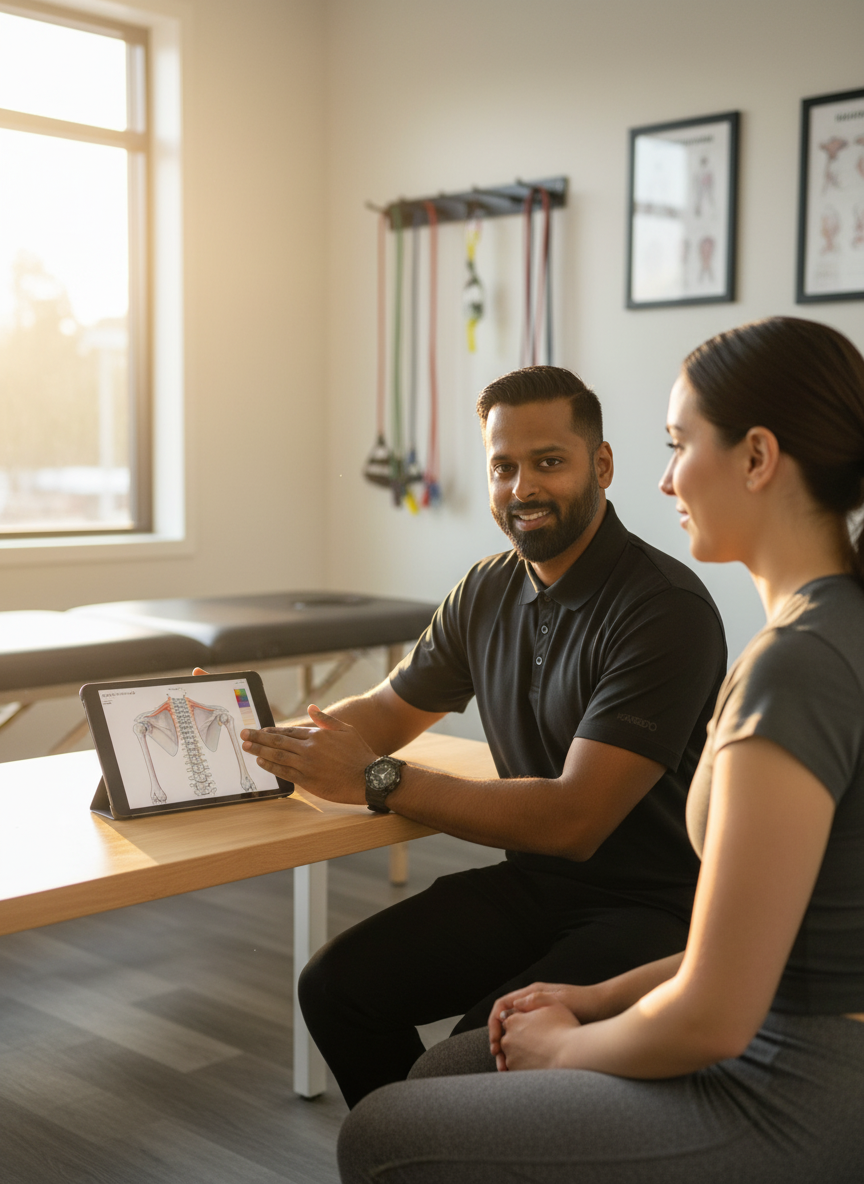
Interdisciplinary Practice & Patient Care
Sanjay practices an integrated model of healthcare, working closely alongside medical doctors inside the Prime Medical Centre on Abell Street to streamline patient recovery pathways. He maintains a human-centric, communication-first clinical framework, ensuring that care remains fully customized rather than automated.
His clinical caseload encompasses a broad operational spectrum under Ontario's regulatory frameworks, including:
Motor Vehicle Accident (MVA) Claims – Rehabilitation navigating Ontario’s statutory accident benefits schedule.
Workplace Safety and Insurance Board (WSIB) – Occupational injury management and return-to-work screening.
Extended Health Care (EHC) & Private Practice – Multi-tier insurance coordination and long-term athletic development plans.
Commitment to Research & Community
Outside of his clinical caseload at Rehab Mechanics and his additional practice affiliations in Etobicoke, Sanjay is an active health writer and community educator. He translates contemporary peer-reviewed medical research into accessible, actionable guidance on his professional blog. As a dedicated father and husband, he mirrors his professional advice in his personal life, focusing on structural mobility, cross-training, and longevity to help his family and his community thrive. Naturally he takes he a keen interest in rehabilitation for women who are pregnant and post-partum.
Disclaimer: The information provided on this blog is intended for educational and informational purposes only. It does not constitute medical advice, diagnosis, or a treatment plan. Always seek the direct advice of a Registered Physiotherapist, physician, or other qualified health provider regarding any medical condition or physical rehabilitation routine.