Can Physiotherapy Cure Chronic Tension Headaches from Desk Work?
Yes. Physiotherapy permanently cures tension headaches by fixing the cervical biomechanics causing them. By mobilizing stiff upper neck joints, releasing suboccipital muscle spasms, and strengthening deep neck flexors, physical therapy eliminates the structural nerve irritation that triggers chronic daily headaches.
The Headache Epidemic in Queen West
In the digital age, our lives are dictated by screens. Whether you are coding a new app in Liberty Village, analyzing spreadsheets in the Financial District, or constantly checking a smartphone, your head is perpetually tilted forward.
The physical toll of this lifestyle is catastrophic for the cervical spine, giving rise to an epidemic of chronic, agonizing head pain. Countless Toronto professionals wake up daily with a dull, vice-like pressure wrapping around their temples, an aching tightness at the base of the skull, or sharp pain radiating behind their eyes.
Often dismissed by walk-in clinics as "just stress" and treated with endless cycles of Advil or Tylenol, these are clinically classified as Cervicogenic or Tension-Type Headaches. When you search for "remedial mechanics" or "Queen Street physiotherapy" to resolve this pain, you are on the right track. At Rehab Mechanics, we know that these headaches are not a chemical imbalance in your brain; they are a direct, mechanical consequence of a failing neck structure. Fixing the spine permanently turns off the headache alarm.
Structural Analysis: The Biomechanics of a Tension Headache
To understand why stretching your neck doesn't cure a severe tension headache, we must dive deep into the neurology and biomechanics of the upper cervical spine.
The Weight of the "Tech Neck"
The human head weighs between 10 and 12 pounds. It is designed to balance perfectly on top of the cervical spine, requiring minimal muscular effort to stay upright.
The Leverage Crisis: For every inch your head translates forward to look at a monitor, the mechanical load on the muscles at the back of your neck doubles.
The Muscular Exhaustion: A severe "Tech Neck" forces the tiny muscles at the base of the skull (the suboccipitals) to hold back 30 to 40 pounds of force for 10 hours a day.
The Spasm: These muscles rapidly fatigue, lose their blood supply (ischemia), and lock into permanent, rock-hard spasms.
The Neurological Bridge (Why Your Head Hurts)
How does a knot in your neck cause pain behind your eye? The answer lies in the complex wiring of the central nervous system.
The Trigeminal-Cervical Nucleus (TCN)
The nerves that supply feeling to the upper three joints of your neck (C1, C2, and C3) merge into a massive relay station in your brainstem called the Trigeminal-Cervical Nucleus.
Crucially, the Trigeminal Nerve—which supplies sensation to your forehead, temples, and face—also plugs into this exact same relay station.
The Crossed Signal: When the joints in your upper neck are jammed and the suboccipital muscles are violently spasming, they flood the relay station with pain signals. The brain gets confused by the sheer volume of data and misinterprets the origin of the pain, projecting it forward into the head and face (Referred Pain).
The Myodural Bridge
Recent anatomical discoveries have revealed that a small band of connective tissue directly links the suboccipital muscles in the neck to the dura mater (the pain-sensitive outer covering of the brain).
When the neck muscles are in severe spasm, they literally tug on the lining of your brain, generating the sensation of a vice crushing your skull.
Primary Source Proof: Cervicogenic Decompression
Neurological and orthopedic literature unequivocally demonstrates that specific cervical spine mobilization and deep neck flexor rehabilitation are vastly superior to pharmacological management for the long-term cure of cervicogenic and tension headaches.
Note: The link above serves as an example of our commitment to evidence-based practice, referencing standard international clinical guidelines for cervical rehabilitation.
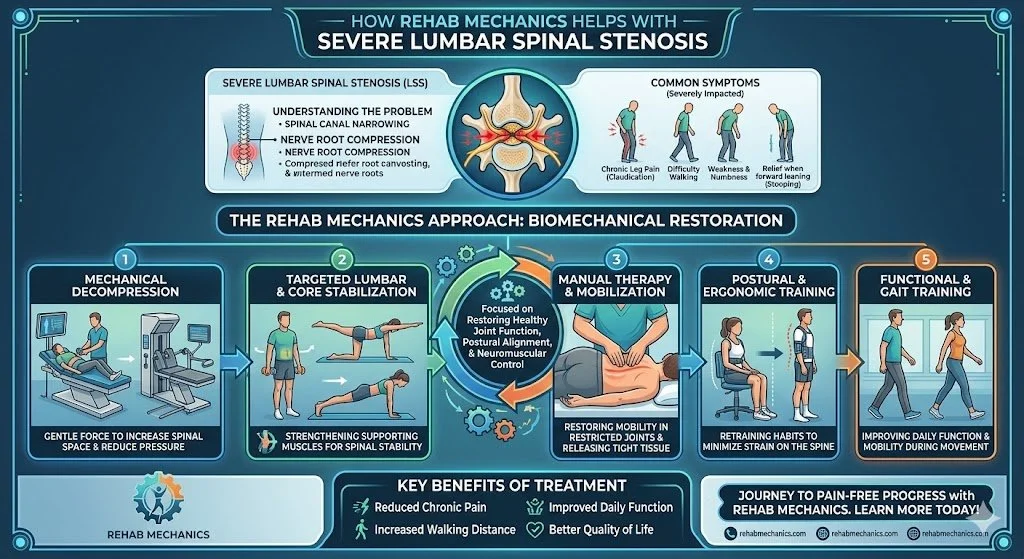
The Rehab Mechanics Headache Eradication Protocol
We do not just massage the sore muscles. Treating cervicogenic headaches requires a profound overhaul of your upper body mechanics to stop the muscles from spasming in the first place.
Phase 1: Decompressing the Neurological Bottleneck
Our first goal is to immediately cut off the pain signals flooding the brainstem.
Upper Cervical Mobilization: Our physiotherapists use precise, gentle Grade II and Grade III manual glides to un-jam the C1, C2, and C3 vertebrae. Restoring the micro-movement of these joints instantly reduces the nerve irritation causing the referred pain.
Suboccipital Ischemic Compression: We apply deep, sustained pressure directly into the base of the skull. This manually breaks the spasm in the suboccipitals, releasing the tension on the "myodural bridge" and draining the pressure from the head.
Phase 2: Restoring the Foundation (Thoracic Extension)
The neck cannot sit straight if the mid-back is hunched over.
Thoracic Spine Unlocking: Utilizing high-level joint mobilizations and foam-roller drills to aggressively restore extension in the upper back.
Pectoral Myofascial Release: Lengthening the tight chest muscles that are physically dragging the shoulders forward and fueling the poor posture.
Phase 3: Rebuilding the Deep Stabilizers
This phase ensures the headaches never return. We must build biological endurance.
Deep Cervical Flexor (DCF) Training: We utilize specific micro-movements (like chin tucks with a pressure biofeedback unit) to re-awaken the dormant muscles in the front of your throat. When these muscles fire properly, they automatically pull the head back over the shoulders, instantly taking the load off the back of the neck.
Postural Ergonomics: We review your exact desk setup, monitor height, and chair support to guarantee your Toronto workspace supports, rather than destroys, your newly restored spinal mechanics.
Turn Off the Headache Alarm
You do not have to accept daily tension headaches or rely on a permanent supply of painkillers. By diagnosing and correcting the mechanical failures in your cervical spine, you can permanently eradicate the pain.
Book a comprehensive neurological and biomechanical assessment with our clinical team today. We are conveniently located inside the Prime Medical Centre at 68 Abell Street, offering advanced orthopedic recovery in Queen West.
Contact us to schedule your appointment:
Email: info@rehabmechanics.com
Phone: (416) 533-3900
About the Author
Mr. Sanjay Attwala (B.Sc., M.Sc., RPT) is a Registered Physiotherapist, clinical director, and the founder of Rehab Mechanics in Toronto. With over 15 years of registered clinical practice and a deep specialization in complex musculoskeletal rehabilitation, Sanjay synthesizes rigorous international academic training with advanced evidence-based therapeutics to guide his clinical practice and patient education initiatives.
Academic Background & Credentials
Master of Science (M.Sc.) in Physiotherapy – University of Keele, United Kingdom (2010).
Bachelor of Science (B.Sc.) – University of Waterloo, Ontario, Canada.
Registered Physiotherapist (RPT) – Regulated health professional in excellent standing with the College of Physiotherapists of Ontario (CPO).
Corporate Entity – Operating officially under the S. Attwala Physiotherapy Professional Corporation with a DBA of Rehab Mechanics.
Clinical Expertise & Philosophy
Sanjay’s clinical approach rejects passive symptom management in favor of identifying underlying biomechanical root causes. His diverse expertise spans advanced manual therapies, personalized corrective exercise prescription, and modern physical modalities. At the Rehab Mechanics Toronto Queen West clinic, he routinely diagnoses and treats complex conditions including:
Spinal & Discogenic Pathology – Cervical, thoracic, and lumbar disc injuries, sciatica, and sacroiliac joint (SIJ) dysfunction.
Upper & Lower Extremity Injuries – Rotator cuff tears, frozen shoulder, tennis/golfer’s elbow, carpal tunnel syndrome, and complex ankle/foot pathologies.
Perinatal & Pelvic Health Rehabilitation – Specialized assessment and rehabilitation protocols tailored specifically for women during pregnancy and the post-partum period, addressing pelvic girdle pain, diastasis recti, and core stabilization.
Specialized Rehabilitation – Pelvic health therapy, TMJ dysfunction, post-surgical rehabilitation (including Total Hip and Total Knee Replacements), and custom orthotics dispensing.
Shockwave Therapy: with advanced cutting edge technological devices to suit your needs.
Interdisciplinary Practice & Patient Care
Sanjay practices an integrated model of healthcare, working closely alongside medical doctors inside the Prime Medical Centre on Abell Street to streamline patient recovery pathways. He maintains a human-centric, communication-first clinical framework, ensuring that care remains fully customized rather than automated.
His clinical caseload encompasses a broad operational spectrum under Ontario's regulatory frameworks, including:
Motor Vehicle Accident (MVA) Claims – Rehabilitation navigating Ontario’s statutory accident benefits schedule.
Workplace Safety and Insurance Board (WSIB) – Occupational injury management and return-to-work screening.
Extended Health Care (EHC) & Private Practice – Multi-tier insurance coordination and long-term athletic development plans.
Commitment to Research & Community
Outside of his clinical caseload at Rehab Mechanics and his additional practice affiliations in Etobicoke, Sanjay is an active health writer and community educator. He translates contemporary peer-reviewed medical research into accessible, actionable guidance on his professional blog. As a dedicated father and husband, he mirrors his professional advice in his personal life, focusing on structural mobility, cross-training, and longevity to help his family and his community thrive. Naturally he takes he a keen interest in rehabilitation for women who are pregnant and post-partum.
Disclaimer: The information provided on this blog is intended for educational and informational purposes only. It does not constitute medical advice, diagnosis, or a treatment plan. Always seek the direct advice of a Registered Physiotherapist, physician, or other qualified health provider regarding any medical condition or physical rehabilitation routine.