Does Pain Behind the Kneecap Mean My Cartilage is Gone?
No. Sharp, grinding pain beneath the kneecap is usually Patellofemoral Pain Syndrome, caused by poor mechanical tracking, not necessarily cartilage loss. Physiotherapy permanently resolves this by strengthening weak glutes, correcting foot pronation, and realigning the kneecap to eliminate the bone-on-bone friction.
The Agony of the Subway Stairs
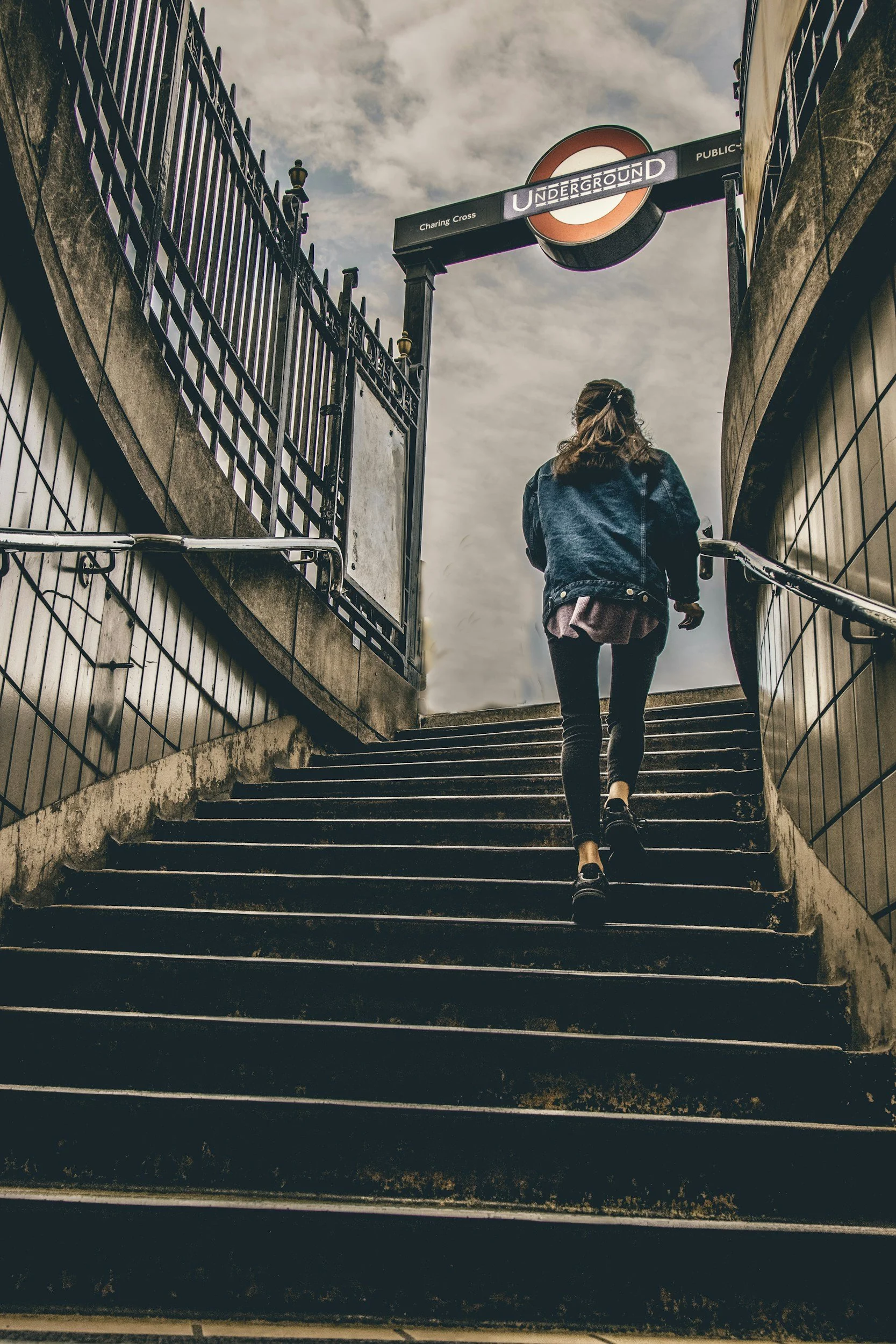
Toronto is a highly vertical city. Whether you are walking down into the depths of a TTC subway station, descending the steep steps of your Queen West apartment, or doing lunges at a local gym, your knees are subjected to immense downward pressure.
For many active urbanites, this daily routine is violently interrupted by a sharp, grinding, or dull aching pain located exactly behind or around the edges of the kneecap. The pain is particularly cruel because it is highly specific: it spikes when walking down stairs, but feels fine walking up. It also creates the classic "movie theater sign," where sitting with your knees bent for a long period (like at a desk or on an airplane) causes a deep, throbbing ache that makes you desperately want to straighten your leg.
When patients experience this "crunching" sensation, they instantly panic, assuming their cartilage has completely worn away and they are doomed to early arthritis. At Rehab Mechanics, we frequently diagnose this as Patellofemoral Pain Syndrome (PFPS), commonly known as Runner's Knee.
The good news is that PFPS is rarely a structural degeneration of the knee itself. It is almost always a biomechanical failure of the hip and foot. By correcting the human mechanics above and below the knee, expert physical therapy can perfectly realign the kneecap and permanently silence the grinding pain.
Structural Analysis: The Mechanics of the Kneecap
To cure Runner's Knee, we must stop looking at the knee in isolation and perform a deep analysis of how the kneecap operates within the entire kinetic chain.
The "Train on the Tracks" Anatomy
Your kneecap (patella) does not float freely. It is a biological pulley embedded inside your massive quadriceps tendon.
The Trochlear Groove: On the front of your thigh bone (femur), there is a V-shaped bony groove.
The Tracking Mechanism: When you bend and straighten your leg, the kneecap is supposed to glide perfectly up and down through the dead-center of this groove, like a train on a track.
The Breakdown: Why the Train Derails
Patellofemoral Pain Syndrome occurs when the kneecap is pulled off-center. Instead of gliding smoothly down the middle of the groove, it violently grinds against the outer bony ridge of the femur.
The Pelvic Drop (The True Culprit)
In 80% of PFPS cases, the knee is actually the innocent victim of a weak hip.
Gluteus Medius Weakness: When you stand on one leg (which happens with every step you take while walking or running), the muscle on the side of your hip (gluteus medius) must fire to keep your pelvis level.
Femoral Internal Rotation: If that hip muscle is weak from sitting at a desk all day, your pelvis drops. This causes your entire thigh bone to collapse and rotate inward (valgus collapse).
The Grinding Friction: While the thigh bone rotates inward, the kneecap is held in place by tight outer leg structures (like the IT band). The result is a massive, highly destructive sheer force that grinds the underside of the kneecap against the femur, inflaming the highly sensitive articular cartilage.
The Foot Foundation (Overpronation)
The problem can also start from the ground up.
If you have flat feet or weak arches (excessive pronation), your foot collapses inward when it strikes the pavement.
This inward collapse violently twists the shin bone (tibia) inward, twisting the knee joint and pulling the kneecap aggressively off its tracking line.
Primary Source Proof: Kinematic Rehabilitation
Orthopedic sports medicine literature emphatically supports the "hip-down" approach, proving that strengthening the posterolateral hip musculature provides significantly faster and more permanent relief for patellofemoral pain than traditional knee-focused exercises.
Review the Clinical Evidence on PubMed: Gluteal Muscle Strengthening for Patellofemoral Pain Syndrome (National Institutes of Health)
Note: The link above directs to external, peer-reviewed medical literature demonstrating our commitment to evidence-based practice and international clinical guidelines for knee rehabilitation.
The Rehab Mechanics Kneecap Tracking Protocol
We do not just ice your knee and give you basic leg lifts. To permanently cure PFPS, we must rewire the biomechanics of your entire lower body.
Phase 1: Pain Modulation and Tissue Release (Weeks 1-3)
Before we can build strength, we must release the tight structures that are physically pulling the kneecap off-center.
IT Band and Lateral Retinaculum Release: Our physiotherapists use advanced, deep myofascial release on the outside of the thigh (TFL and vastus lateralis). By loosening these extremely tight structures, we instantly provide mechanical slack, allowing the kneecap to drift back toward the center of the groove.
Patellar Taping (McConnell Taping): We apply rigid kinesiology tape directly over the kneecap, physically taping it into the center of the groove. This mechanically unloads the inflamed tissue and allows you to walk down stairs pain-free while we rehabilitate the muscles.
Phase 2: Hip Isolation and Foundation Fortification (Weeks 4-6)
We must build the muscular scaffolding that prevents the thigh bone from collapsing inward.
Isolated Gluteal Activation: Utilizing targeted, side-lying hip abductions, banded clamshells, and isometric holds to wake up the dormant lateral stabilizers of the pelvis.
VMO Retraining: We use specific biofeedback to teach your brain to fire the vastus medialis oblique (the teardrop-shaped muscle on the inside of the knee) earlier in the movement cycle, actively pulling the kneecap inward against the lateral friction.
Phase 3: Dynamic Integration and Gait Retraining (Weeks 6-10)
Strength on a treatment table means nothing if it doesn't translate to the sidewalk.
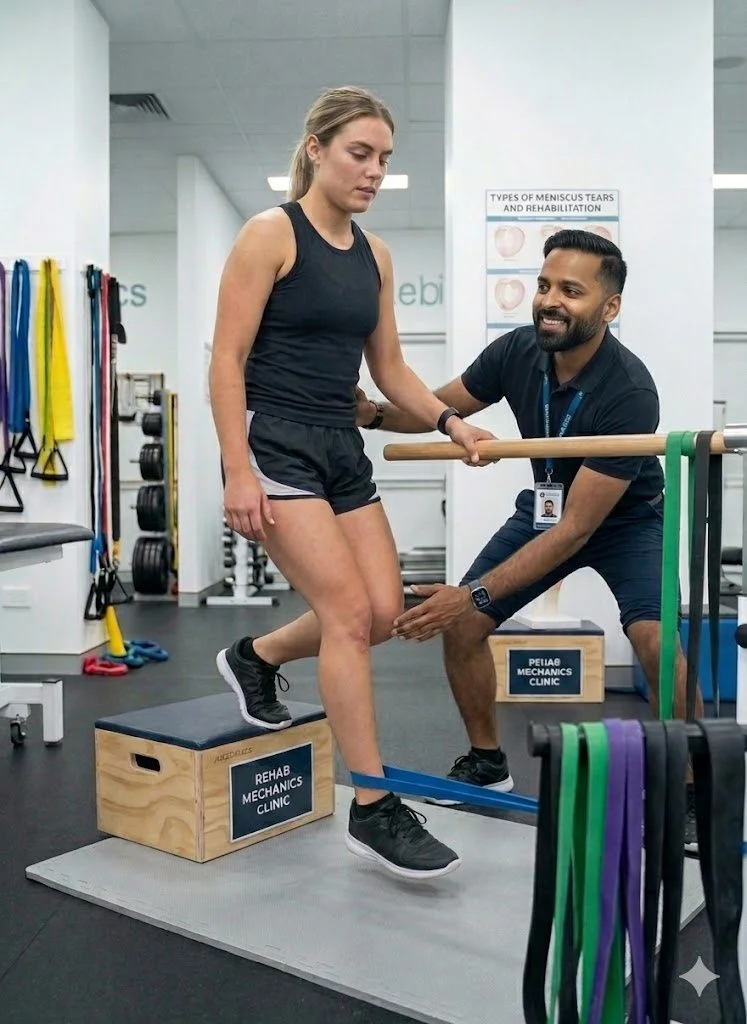
Anti-Valgus Training: We progress to dynamic step-downs, lateral lunges, and single-leg squats while utilizing tactile feedback (like a resistance band pulling the knee inward) to force your brain to consciously fire the glutes and push the knee straight.
Foot Mechanics Check: If structural overpronation is driving the knee pain, Sanjay is qualified to assess and dispense custom medical orthotics to permanently support the arch and align the shin bone.
Silence the Grinding Joint
You do not have to live with the fear of stairs or the chronic, aching pain of runner's knee. By identifying and correcting the foundational biomechanics of your hips and feet, physical therapy offers a permanent, non-surgical solution to patellofemoral pain.
Book a comprehensive biomechanical knee assessment with our clinical team today. We are conveniently located inside the Prime Medical Centre at 68 Abell Street, offering elite sports recovery in Queen West.
Contact us to schedule your appointment:
Email: info@rehabmechanics.com
Phone: (416) 533-3900
About the Author
Mr. Sanjay Attwala (B.Sc., M.Sc., RPT) is a Registered Physiotherapist, clinical director, and the founder of Rehab Mechanics in Toronto. With over 15 years of registered clinical practice and a deep specialization in complex musculoskeletal rehabilitation, Sanjay synthesizes rigorous international academic training with advanced evidence-based therapeutics to guide his clinical practice and patient education initiatives.
Academic Background & Credentials
Master of Science (M.Sc.) in Physiotherapy – University of Keele, United Kingdom (2010).
Bachelor of Science (B.Sc.) – University of Waterloo, Ontario, Canada.
Registered Physiotherapist (RPT) – Regulated health professional in excellent standing with the College of Physiotherapists of Ontario (CPO).
Corporate Entity – Operating officially under the S. Attwala Physiotherapy Professional Corporation with a DBA of Rehab Mechanics.
Clinical Expertise & Philosophy
Sanjay’s clinical approach rejects passive symptom management in favor of identifying underlying biomechanical root causes. His diverse expertise spans advanced manual therapies, personalized corrective exercise prescription, and modern physical modalities. At the Rehab Mechanics Toronto Queen West clinic, he routinely diagnoses and treats complex conditions including:
Spinal & Discogenic Pathology – Cervical, thoracic, and lumbar disc injuries, sciatica, and sacroiliac joint (SIJ) dysfunction.
Upper & Lower Extremity Injuries – Rotator cuff tears, frozen shoulder, tennis/golfer’s elbow, carpal tunnel syndrome, and complex ankle/foot pathologies.
Perinatal & Pelvic Health Rehabilitation – Specialized assessment and rehabilitation protocols tailored specifically for women during pregnancy and the post-partum period, addressing pelvic girdle pain, diastasis recti, and core stabilization.
Specialized Rehabilitation – Pelvic health therapy, TMJ dysfunction, post-surgical rehabilitation (including Total Hip and Total Knee Replacements), and custom orthotics dispensing.
Shockwave Therapy: with advanced cutting edge technological devices to suit your needs.
Interdisciplinary Practice & Patient Care
Sanjay practices an integrated model of healthcare, working closely alongside medical doctors inside the Prime Medical Centre on Abell Street to streamline patient recovery pathways. He maintains a human-centric, communication-first clinical framework, ensuring that care remains fully customized rather than automated.
His clinical caseload encompasses a broad operational spectrum under Ontario's regulatory frameworks, including:
Motor Vehicle Accident (MVA) Claims – Rehabilitation navigating Ontario’s statutory accident benefits schedule.
Workplace Safety and Insurance Board (WSIB) – Occupational injury management and return-to-work screening.
Extended Health Care (EHC) & Private Practice – Multi-tier insurance coordination and long-term athletic development plans.
Commitment to Research & Community
Outside of his clinical caseload at Rehab Mechanics and his additional practice affiliations in Etobicoke, Sanjay is an active health writer and community educator. He translates contemporary peer-reviewed medical research into accessible, actionable guidance on his professional blog. As a dedicated father and husband, he mirrors his professional advice in his personal life, focusing on structural mobility, cross-training, and longevity to help his family and his community thrive. Naturally he takes he a keen interest in rehabilitation for women who are pregnant and post-partum.
Disclaimer: The information provided on this blog is intended for educational and informational purposes only. It does not constitute medical advice, diagnosis, or a treatment plan. Always seek the direct advice of a Registered Physiotherapist, physician, or other qualified health provider regarding any medical condition or physical rehabilitation routine.