
Can Physiotherapy Fix Rotator Cuff Pain Without Cortisone Injections?
Yes. Targeted physiotherapy can permanently resolve rotator cuff tendinopathy without repeated cortisone injections. By correcting scapular (shoulder blade) mechanics, restoring thoracic spine mobility, and progressively strengthening the rotator cuff tendons, physiotherapy eliminates the structural impingement causing the pain.
The "Weekend Warrior" Shoulder Epidemic
Parkdale and Queen West are home to an incredibly active demographic. From heavy lifting at local strength and conditioning gyms to weekend tennis matches and recreational baseball, the residents of Toronto push their upper bodies to the limit.
Consequently, searches for "physiotherapy Parkdale" frequently revolve around one notoriously stubborn injury: rotator cuff pain.
When you experience a sharp, catching pain in your shoulder while reaching into the backseat of your car, or a dull, throbbing ache that keeps you awake at night, the medical system often defaults to a quick fix. You may visit a walk-in clinic and receive a cortisone injection. While this provides temporary chemical relief, the pain almost always returns a few months later.
At Rehab Mechanics, we want patients to understand that chemical injections do not fix mechanical problems. To permanently eliminate shoulder pain, you must rebuild the structural integrity of the joint through advanced biomechanical physiotherapy.
Structural Analysis: The Mechanics of Shoulder Impingement
To understand why exercise cures the shoulder better than an injection, we must analyze the anatomy of the rotator cuff and the mechanics of "impingement."
The Anatomy of the Cuff
The rotator cuff is not a single muscle; it is a group of four small muscles (Supraspinatus, Infraspinatus, Teres Minor, and Subscapularis) that originate on your shoulder blade and wrap around the head of your upper arm bone (humerus).
The Primary Job: Their job is not to lift heavy weights. Their job is to pull the head of the humerus tightly into the shoulder socket, keeping the joint centralized and stable while your larger muscles (deltoids, pecs, lats) do the heavy lifting.
The Subacromial Space and Impingement
The tendons of the rotator cuff pass through a very narrow bony tunnel in the shoulder called the subacromial space.
The Postural Collapse
If you spend 40 hours a week hunched over a laptop, your chest muscles (pecs) become chronically tight, and your upper back muscles become weak. This pulls your shoulder blades forward and tilts them down.
The Mechanical Pinch
When the shoulder blade is tilted forward, that narrow subacromial tunnel becomes even smaller. Now, when you try to lift your arm to serve a tennis ball or press a dumbbell, the arm bone literally crushes the rotator cuff tendons against the roof of the shoulder blade.
This mechanical crushing causes micro-tears, severe inflammation, and eventual tendinopathy. A cortisone shot reduces the inflammation, but the moment you lift your arm again, the crushing resumes.
Primary Source Proof: Corticosteroids vs. Exercise Therapy
Extensive orthopedic research indicates that while corticosteroid injections offer short-term pain relief, progressive exercise therapy provides superior long-term functional outcomes and reduces the risk of tendon rupture.
Note: The link above serves as an example of our commitment to evidence-based practice, referencing standard international clinical guidelines for shoulder rehabilitation.
The Rehab Mechanics Rotator Cuff Protocol
To truly fix a rotator cuff, we must open up the subacromial space and build resilient, thick tendons. Our Parkdale and Queen West patients undergo a rigorous, three-phase protocol.
Phase 1: Creating Mechanical Space (Weeks 1-3)
Before we strengthen the cuff, we must stop the crushing.
Thoracic Mobilization: We use manual therapy to aggressively mobilize the mid-back. If your spine cannot extend, your shoulder blades cannot rotate backward.
Pectoral Release: Deep myofascial release on the pectoralis minor to allow the shoulder blades to sit back in a neutral, healthy position.
Pain Management: Utilizing clinical modalities (like TENS or gentle traction) to lower the acute inflammatory pain safely.
Phase 2: Scapular Stabilization (Weeks 4-6)
We must build a strong foundation. You cannot fire a cannon from a canoe.
Lower Trapezius Activation: Exercises designed to train the muscles at the bottom of the shoulder blade to pull it down and away from the impingement zone.
Serratus Anterior Strengthening: The "boxer's muscle" is crucial for keeping the shoulder blade glued to the ribcage during overhead movements.
Phase 3: Cuff Loading and Tissue Remodeling (Weeks 6+)
This is where the tendon is permanently repaired.
Eccentric Loading: Tendons heal best under tension. We use slow, controlled resistance band exercises to lengthen the rotator cuff muscles under load, stimulating the production of new, strong collagen fibers.
Proprioceptive Stabilization: Using unstable surfaces (like a kettlebell bottoms-up press) to force the rotator cuff to react instantly and centralize the joint during chaotic movements.
Stop the Cycle of Shoulder Pain
Do not let repeated cortisone injections deteriorate your tendon quality. Fix the biomechanics of your shoulder and return to your active lifestyle safely.
Book a comprehensive upper body assessment with our clinical team today. We are conveniently located inside the Prime Medical Centre at 68 Abell Street, easily accessible for Parkdale and Queen West residents.
Contact us to schedule your appointment:
Email: info@rehabmechanics.com
Phone: (416) 533-3900
About the Author
Mr. Sanjay Attwala (B.Sc., M.Sc., RPT) is a Registered Physiotherapist, clinical director, and the founder of Rehab Mechanics in Toronto. With over 15 years of registered clinical practice and a deep specialization in complex musculoskeletal rehabilitation, Sanjay synthesizes rigorous international academic training with advanced evidence-based therapeutics to guide his clinical practice and patient education initiatives.
Academic Background & Credentials
Master of Science (M.Sc.) in Physiotherapy – University of Keele, United Kingdom (2010).
Bachelor of Science (B.Sc.) – University of Waterloo, Ontario, Canada.
Registered Physiotherapist (RPT) – Regulated health professional in excellent standing with the College of Physiotherapists of Ontario (CPO).
Corporate Entity – Operating officially under the S. Attwala Physiotherapy Professional Corporation with a DBA of Rehab Mechanics.
Clinical Expertise & Philosophy
Sanjay’s clinical approach rejects passive symptom management in favor of identifying underlying biomechanical root causes. His diverse expertise spans advanced manual therapies, personalized corrective exercise prescription, and modern physical modalities. At the Rehab Mechanics Toronto Queen West clinic, he routinely diagnoses and treats complex conditions including:
Spinal & Discogenic Pathology – Cervical, thoracic, and lumbar disc injuries, sciatica, and sacroiliac joint (SIJ) dysfunction.
Upper & Lower Extremity Injuries – Rotator cuff tears, frozen shoulder, tennis/golfer’s elbow, carpal tunnel syndrome, and complex ankle/foot pathologies.
Perinatal & Pelvic Health Rehabilitation – Specialized assessment and rehabilitation protocols tailored specifically for women during pregnancy and the post-partum period, addressing pelvic girdle pain, diastasis recti, and core stabilization.
Specialized Rehabilitation – Pelvic health therapy, TMJ dysfunction, post-surgical rehabilitation (including Total Hip and Total Knee Replacements), and custom orthotics dispensing.
Shockwave Therapy: with advanced cutting edge technological devices to suit your needs.
Interdisciplinary Practice & Patient Care
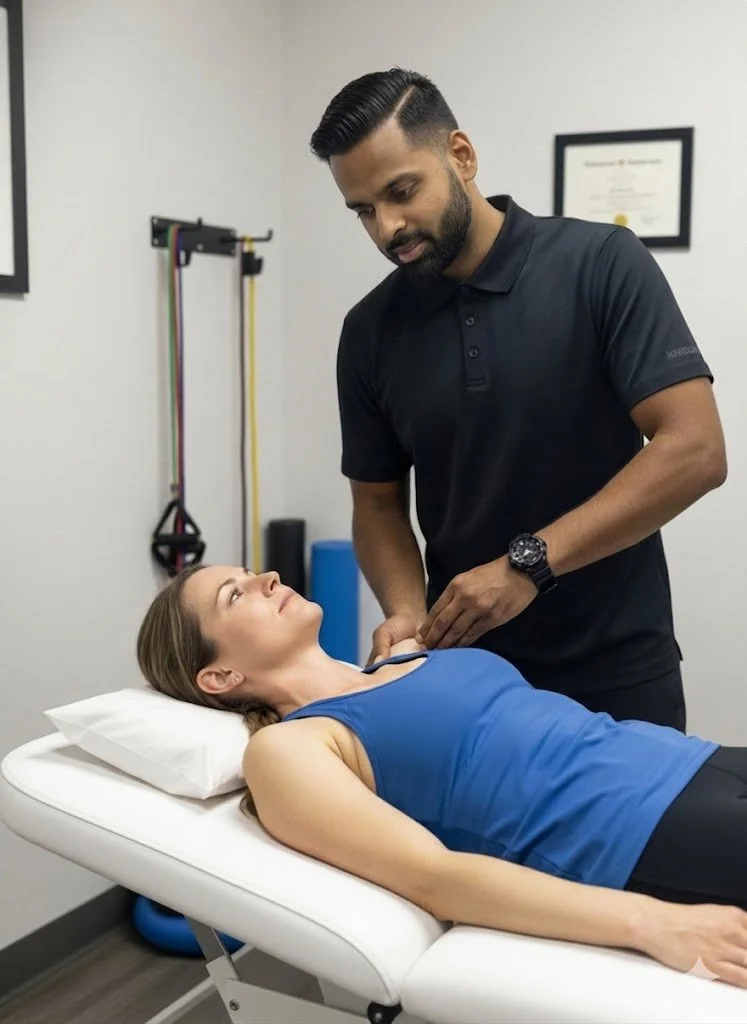
Sanjay practices an integrated model of healthcare, working closely alongside medical doctors inside the Prime Medical Centre on Abell Street to streamline patient recovery pathways. He maintains a human-centric, communication-first clinical framework, ensuring that care remains fully customized rather than automated.
His clinical caseload encompasses a broad operational spectrum under Ontario's regulatory frameworks, including:
Motor Vehicle Accident (MVA) Claims – Rehabilitation navigating Ontario’s statutory accident benefits schedule.
Workplace Safety and Insurance Board (WSIB) – Occupational injury management and return-to-work screening.
Extended Health Care (EHC) & Private Practice – Multi-tier insurance coordination and long-term athletic development plans.
Commitment to Research & Community
Outside of his clinical caseload at Rehab Mechanics and his additional practice affiliations in Etobicoke, Sanjay is an active health writer and community educator. He translates contemporary peer-reviewed medical research into accessible, actionable guidance on his professional blog. As a dedicated father and husband, he mirrors his professional advice in his personal life, focusing on structural mobility, cross-training, and longevity to help his family and his community thrive. Naturally he takes he a keen interest in rehabilitation for women who are pregnant and post-partum.


Disclaimer: The information provided on this blog is intended for educational and informational purposes only. It does not constitute medical advice, diagnosis, or a treatment plan. Always seek the direct advice of a Registered Physiotherapist, physician, or other qualified health provider regarding any medical condition or physical rehabilitation routine.