
Can Physiotherapy Relieve the Sharp Groin Pain of Hip Impingement?
Yes. Physiotherapy provides profound relief for hip impingement (FAI). By restoring joint capsule mobility, strengthening the deep hip rotators, and correcting pelvic tilt, physiotherapy mechanically decompresses the hip joint, eliminating the sharp, pinching groin pain associated with femoroacetabular impingement.
The Mystery of Chronic Groin Pain
Groin pain is one of the most frustrating and frequently misdiagnosed complaints in sports medicine. For many active individuals in Toronto—whether they are avid cyclists riding along the waterfront, hockey players in local recreational leagues, or simply office workers who sit for 8 hours a day—a deep, pinching sensation in the front crease of the hip can quickly derail their lifestyle.
Often, patients assume they have simply pulled a "groin muscle" (adductor strain) and attempt to aggressively stretch it out. However, if stretching the hip makes the pinching sensation worse, or if you feel a sharp block when trying to pull your knee to your chest, you are likely not dealing with a muscle issue at all. You are dealing with a bone-on-bone structural conflict known as Femoroacetabular Impingement (FAI).
At Rehab Mechanics in Queen West, we specialize in the complex biomechanics of the hip and pelvis. We understand that FAI is a mechanical "jamming" of the joint. Through highly targeted physical therapy, we can alter the angle of your pelvis and the strength of your hip stabilizers to physically create more space inside the joint, stopping the painful friction without the need for invasive arthroscopic surgery.
Structural Analysis: The Mechanics of a Hip Pinch
To understand how to fix FAI, we must perform a biomechanical analysis of the hip joint's architecture and the bony changes that trigger impingement.
The Ball and Socket Architecture
Your hip is a massive, deep ball-and-socket joint. The "ball" is the femoral head (the top of your thigh bone), and the "socket" is the acetabulum (a deep cup in your pelvis).
In a healthy hip, the ball glides smoothly within the socket, lubricated by synovial fluid and protected by a thick ring of cartilage called the labrum.
The Bony Overgrowth (FAI)
Impingement occurs when extra bone grows on either the ball, the socket, or both. This overgrowth destroys the perfect spherical fit of the joint.
CAM Lesion: Extra bone grows on the neck of the femur (the ball). As you bend your hip up, this non-spherical bump forcefully jams into the rim of the socket.
Pincer Lesion: Extra bone extends out over the rim of the acetabulum (the socket), creating an "overhang" that crushes the femoral neck during movement.
The Danger to the Labrum
When these bony abnormalities violently crash into each other during activities like deep squatting, running, or sitting in low chairs, they trap the delicate labrum between them.
The Tearing Process
Over time, this relentless mechanical crushing causes the labrum to fray and eventually tear, leading to a deep, catching, or clicking pain deep inside the groin. If left untreated, the friction rapidly wears away the articular cartilage, accelerating early-onset hip osteoarthritis.
The Biomechanical Trigger: Anterior Pelvic Tilt
While you cannot exercise away a bony bump, you can completely alter how that bump interacts with the socket.
Many people with FAI sit for hours a day, developing extremely tight hip flexors.
This tightness pulls the entire pelvis forward and downward (an anterior pelvic tilt).
When the pelvis tilts forward, the roof of the hip socket physically lowers, drastically closing the space and making the bony impingement exponentially worse.
Primary Source Proof: Conservative Management of FAI
Orthopedic and sports medicine research strongly supports non-operative, physiotherapist-led rehabilitation as the primary, highly effective first-line intervention for Femoroacetabular Impingement, often successfully avoiding surgical intervention.
Download Clinical Efficacy PDF: The Efficacy of Physiotherapist-Led Rehabilitation in the Management of Femoroacetabular Impingement Syndrome (Open Access Medical Review)
Note: The link above serves as an example of our commitment to evidence-based practice, referencing standard international clinical guidelines for hip rehabilitation.
The Rehab Mechanics Impingement Protocol
Our clinical goal is mechanical decompression. We must change the resting position of the pelvis and teach the femoral head to glide inferiorly (downward) to clear the impingement zone during movement.
Phase 1: Joint Decompression and Soft Tissue Release
We must physically create space in the cramped joint capsule.
Manual Joint Distraction: Our physiotherapists use heavy, hands-on traction bands to gently pull the femur out of the socket. This immediately relieves the pressure on the crushed labrum and stretches the incredibly dense, tight posterior hip capsule.
Hip Flexor and TFL Release: Aggressive manual soft tissue mobilization on the muscles at the front of the hip to release the "brakes" that are pulling the pelvis into that dangerous anterior tilt.
Phase 2: Pelvic Realignment and Deep Core Activation
We must teach your body how to hold the pelvis in a neutral position to permanently open the front of the hip socket.
Posterior Pelvic Tilt Training: Utilizing targeted lower abdominal training (transversus abdominis) to teach the nervous system how to rotate the pelvis backward, instantly lifting the roof of the socket away from the impingement.
Gluteus Maximus Fortification: The large glute muscles pull the pelvis backward. We use specific bridges and heavy hip thrusts to build the primary muscles responsible for fighting the tight hip flexors.
Phase 3: Dynamic Hip Control and Glute Medius Strengthening
The hip must remain centralized dynamically, meaning when you are walking or playing sports.
Deep Rotator Activation: Strengthening the tiny muscles deep under the glutes (like the piriformis and obturators) that act as the rotator cuff of the hip, keeping the ball perfectly centered in the socket.
Functional Movement Modification: We analyze your squat and running form. For instance, teaching a weightlifter to adopt a slightly wider stance with toes pointed outward can instantly clear the bony block, allowing them to squat heavy without pain.
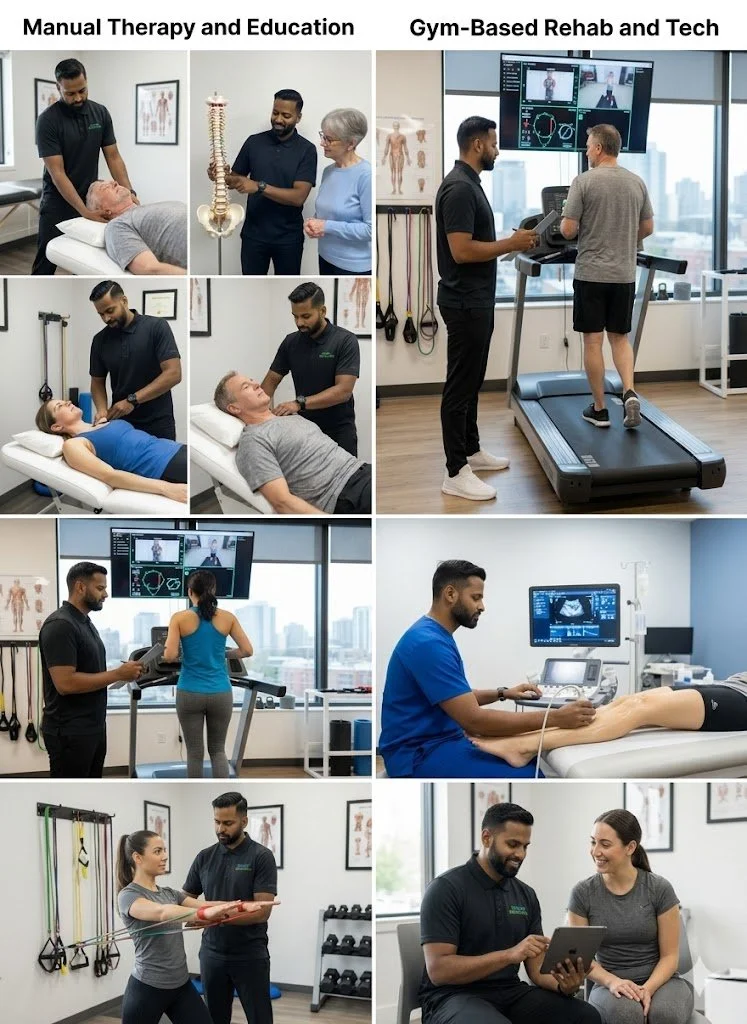
Stop the Friction and Save Your Labrum
Do not let chronic groin pain progress into a severe labral tear or early arthritis. By correcting your pelvic mechanics and building robust hip stability, you can eliminate the pinching and return to the sports you love.
Book a comprehensive biomechanical hip assessment with our clinical team today. We are conveniently located inside the Prime Medical Centre at 68 Abell Street, offering elite orthopedic care in Queen West.
Contact us to schedule your appointment:
Email: info@rehabmechanics.com
Phone: (416) 533-3900
About the Author
Mr. Sanjay Attwala (B.Sc., M.Sc., RPT) is a Registered Physiotherapist, clinical director, and the founder of Rehab Mechanics in Toronto. With over 15 years of registered clinical practice and a deep specialization in complex musculoskeletal rehabilitation, Sanjay synthesizes rigorous international academic training with advanced evidence-based therapeutics to guide his clinical practice and patient education initiatives.
Academic Background & Credentials
Master of Science (M.Sc.) in Physiotherapy – University of Keele, United Kingdom (2010).
Bachelor of Science (B.Sc.) – University of Waterloo, Ontario, Canada.
Registered Physiotherapist (RPT) – Regulated health professional in excellent standing with the College of Physiotherapists of Ontario (CPO).
Corporate Entity – Operating officially under the S. Attwala Physiotherapy Professional Corporation with a DBA of Rehab Mechanics.
Clinical Expertise & Philosophy
Sanjay’s clinical approach rejects passive symptom management in favor of identifying underlying biomechanical root causes. His diverse expertise spans advanced manual therapies, personalized corrective exercise prescription, and modern physical modalities. At the Rehab Mechanics Toronto Queen West clinic, he routinely diagnoses and treats complex conditions including:
Spinal & Discogenic Pathology – Cervical, thoracic, and lumbar disc injuries, sciatica, and sacroiliac joint (SIJ) dysfunction.
Upper & Lower Extremity Injuries – Rotator cuff tears, frozen shoulder, tennis/golfer’s elbow, carpal tunnel syndrome, and complex ankle/foot pathologies.
Perinatal & Pelvic Health Rehabilitation – Specialized assessment and rehabilitation protocols tailored specifically for women during pregnancy and the post-partum period, addressing pelvic girdle pain, diastasis recti, and core stabilization.
Specialized Rehabilitation – Pelvic health therapy, TMJ dysfunction, post-surgical rehabilitation (including Total Hip and Total Knee Replacements), and custom orthotics dispensing.
Shockwave Therapy: with advanced cutting edge technological devices to suit your needs.
Interdisciplinary Practice & Patient Care
Sanjay practices an integrated model of healthcare, working closely alongside medical doctors inside the Prime Medical Centre on Abell Street to streamline patient recovery pathways. He maintains a human-centric, communication-first clinical framework, ensuring that care remains fully customized rather than automated.
His clinical caseload encompasses a broad operational spectrum under Ontario's regulatory frameworks, including:
Motor Accident (MVA) Claims – Rehabilitation navigating Ontario’s statutory accident benefits schedule.
Workplace Safety and Insurance Board (WSIB) – Occupational injury management and return-to-work screening.
Extended Health Care (EHC) & Private Practice – Multi-tier insurance coordination and long-term athletic development plans.
Commitment to Research & Community
Outside of his clinical caseload at Rehab Mechanics and his additional practice affiliations in Etobicoke, Sanjay is an active health writer and community educator. He translates contemporary peer-reviewed medical research into accessible, actionable guidance on his professional blog. As a dedicated father and husband, he mirrors his professional advice in his personal life, focusing on structural mobility, cross-training, and longevity to help his family and his community thrive. Naturally he takes he a keen interest in rehabilitation for women who are pregnant and post-partum.
Disclaimer: The information provided on this blog is intended for educational and informational purposes only. It does not constitute medical advice, diagnosis, or a treatment plan. Always seek the direct advice of a Registered Physiotherapist, physician, or other qualified health provider regarding any medical condition or physical rehabilitation routine.