Can Treatment for Poor Movement Mechanics Permanently Fix Chronic Joint Pain?
Yes. Chronic joint pain is rarely random; it is the physical consequence of poor movement mechanics. By identifying and correcting the specific compensatory patterns that overload your tissues, biomechanical physiotherapy permanently resolves the root cause of your chronic pain.
The Illusion of Random Injury
"I just bent over to tie my shoe, and my back went out." "I was just jogging on a flat path when my knee flared up."
At Rehab Mechanics, we hear these stories every day. For active residents of Queen West and Trinity Bellwoods, injuries often feel like sudden, random acts of misfortune. However, the human body is an incredibly resilient machine. Ligaments, tendons, and discs do not simply snap under normal, low-level loads like bending over or jogging.
When you search for "treatment for poor movement mechanics" or "remedial mechanics," you are tapping into the core philosophy of advanced physical therapy: the injury you felt today is actually the culmination of thousands of faulty movements you made over the last six months.
If you do not fix the underlying movement mechanics, the injury will inevitably return, regardless of how much ice, rest, or massage you apply. True healing requires a complete audit of how your nervous system coordinates the kinetic chain.
Structural Analysis: The Danger of Compensatory Patterns
To understand why fixing movement mechanics is the only permanent cure for joint pain, we must perform a deep dive into the concept of neurological compensation.
The Rule of the Kinetic Chain
Your body is a linked system of joints that alternate between requiring mobility and requiring stability.
Your ankle needs mobility.
Your knee needs stability.
Your hip needs mobility.
Your lumbar spine needs stability.
The Breakdown: Neurological Compensation
When one joint fails to do its job, the nervous system instantly forces the adjacent joint to do the work instead. This is called a "compensatory pattern," and it is the root cause of almost all non-traumatic orthopedic pain.
The Glute-Hamstring Shift
Consider the action of running or walking. Your gluteus maximus (your primary hip extensor) should be the main engine driving you forward.
The Inhibition: Due to hours of sitting at a desk, your hip flexors become tight, which neurologically "shuts off" or inhibits your glute muscles.
The Compensation: Your brain still needs you to walk, so it recruits your hamstrings and your lower back muscles to do the job of the glutes.
The Tissue Failure: Hamstrings and spinal erectors are not designed to be primary propulsive engines. Because they are overworked, they become chronically tight, form severe trigger points, and eventually tear.
The Treatment Fallacy
If you go to a standard clinic, they will massage your tight hamstrings and heat your sore lower back. This provides relief for exactly one day. The moment you stand up and walk with the same poor movement mechanics, the hamstrings are immediately overloaded again.
Primary Source Proof: Kinematic Rehabilitation
Sports medicine literature overwhelmingly supports kinematic (movement-based) interventions over passive treatments for long-term resolution of musculoskeletal pathologies.
Download Clinical Efficacy PDF: The Role of Biomechanical Assessment and Kinematic Correction in Chronic Musculoskeletal Pain (Open Access Medical Review)
Note: The link above serves as an example of our commitment to evidence-based practice, referencing standard international clinical guidelines for movement science.
The Rehab Mechanics Corrective Protocol
We do not treat the victim; we treat the culprit. Repairing poor movement mechanics requires a rigorous, phased approach to rewire your nervous system.
Phase 1: The Functional Movement Screen (FMS)
Before we treat you, we must map your movement.
Overhead Squat Assessment: This single movement reveals bilateral imbalances, ankle mobility deficits, and core instability instantly.
Single-Leg Loading: Watching how you balance on one leg tells us exactly how your gluteus medius is (or isn't) stabilizing your pelvis.
Gait Analysis: Breaking down your walking or running stride to identify overpronation, early heel rise, or pelvic drop.
Phase 2: Restoring Tissue Quality and Range of Motion
We must clear the physical roadblocks before the brain can learn new movements.
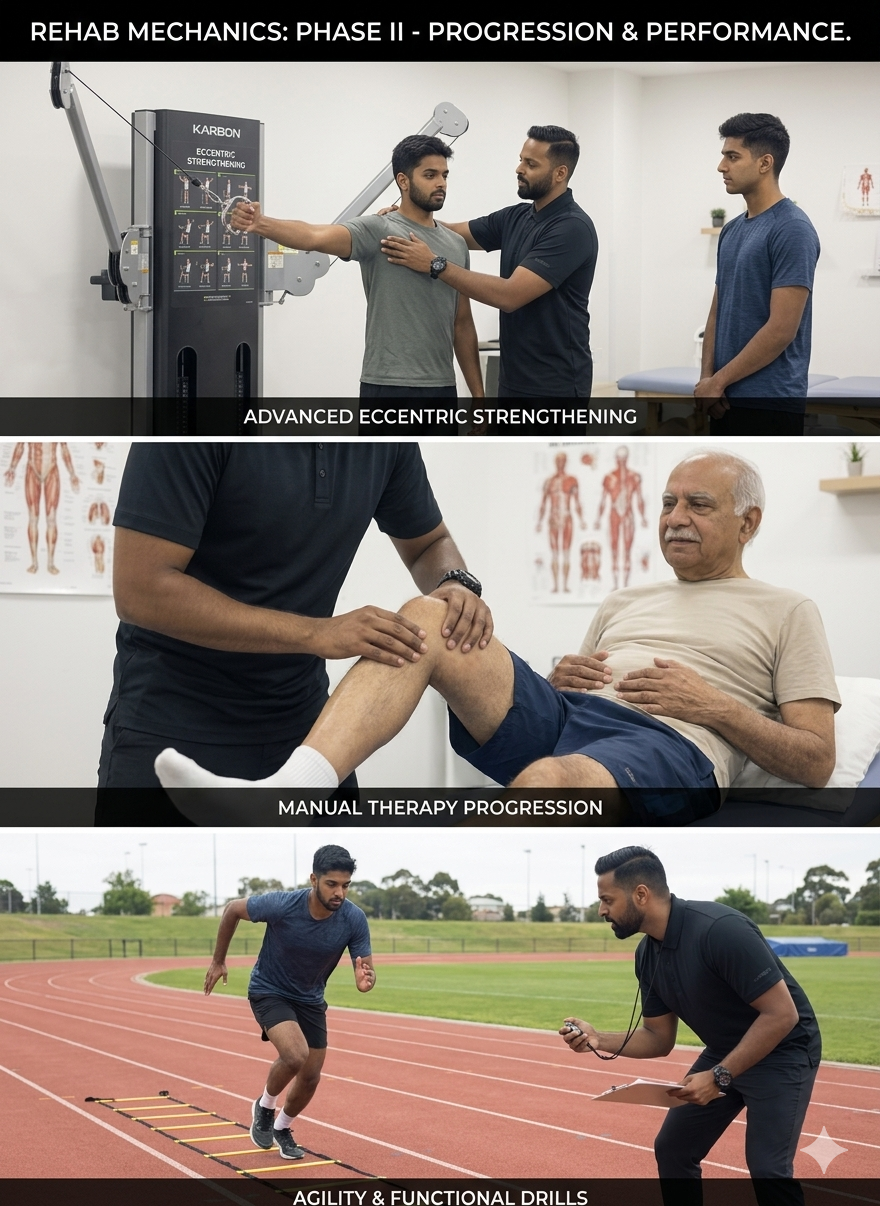
Myofascial Release: Utilizing advanced manual therapy to break down the dense fascial adhesions that are physically pulling your joints out of alignment.
Joint Mobilization: Unlocking stiff joint capsules (like the ankle or thoracic spine) to ensure the limb actually has the capacity to move through a full, healthy range.
Phase 3: Neuromuscular Re-education
This is the most critical phase. We must teach your brain the correct way to move.
Isolated Motor Control: Prescribing micro-movements to "wake up" dormant muscles without allowing the larger, compensatory muscles to take over.
Progressive Integration: Once the muscle fires correctly in isolation, we integrate it into compound movements (like lunges or deadlifts), ensuring the entire kinetic chain operates synchronously.
High-Load Resilience: Finally, we load the movement with heavy resistance to permanently cement the new motor pattern into your nervous system, ensuring you can lift, run, and live safely.
Rebuild Your Body's Foundation
Do not settle for a life of temporary fixes and recurring injuries. By addressing your foundational movement mechanics, you can eliminate the hidden forces destroying your joints.
Book a comprehensive biomechanical assessment with our clinical team today. We are conveniently located inside the Prime Medical Centre at 68 Abell Street in Toronto.
Contact us to schedule your appointment:
Email: info@rehabmechanics.com
Phone: (416) 533-3900
About the Author
Mr. Sanjay Attwala (B.Sc., M.Sc., RPT) is a Registered Physiotherapist, clinical director, and the founder of Rehab Mechanics in Toronto. With over 15 years of registered clinical practice and a deep specialization in complex musculoskeletal rehabilitation, Sanjay synthesizes rigorous international academic training with advanced evidence-based therapeutics to guide his clinical practice and patient education initiatives.
Academic Background & Credentials
Master of Science (M.Sc.) in Physiotherapy – University of Keele, United Kingdom (2010).
Bachelor of Science (B.Sc.) – University of Waterloo, Ontario, Canada.
Registered Physiotherapist (RPT) – Regulated health professional in excellent standing with the College of Physiotherapists of Ontario (CPO).
Corporate Entity – Operating officially under the S. Attwala Physiotherapy Professional Corporation with a DBA of Rehab Mechanics.
Clinical Expertise & Philosophy
Sanjay’s clinical approach rejects passive symptom management in favor of identifying underlying biomechanical root causes. His diverse expertise spans advanced manual therapies, personalized corrective exercise prescription, and modern physical modalities. At the Rehab Mechanics Toronto Queen West clinic, he routinely diagnoses and treats complex conditions including:
Spinal & Discogenic Pathology – Cervical, thoracic, and lumbar disc injuries, sciatica, and sacroiliac joint (SIJ) dysfunction.
Upper & Lower Extremity Injuries – Rotator cuff tears, frozen shoulder, tennis/golfer’s elbow, carpal tunnel syndrome, and complex ankle/foot pathologies.
Perinatal & Pelvic Health Rehabilitation – Specialized assessment and rehabilitation protocols tailored specifically for women during pregnancy and the post-partum period, addressing pelvic girdle pain, diastasis recti, and core stabilization.
Specialized Rehabilitation – Pelvic health therapy, TMJ dysfunction, post-surgical rehabilitation (including Total Hip and Total Knee Replacements), and custom orthotics dispensing.
Shockwave Therapy: with advanced cutting edge technological devices to suit your needs.
Interdisciplinary Practice & Patient Care
Sanjay practices an integrated model of healthcare, working closely alongside medical doctors inside the Prime Medical Centre on Abell Street to streamline patient recovery pathways. He maintains a human-centric, communication-first clinical framework, ensuring that care remains fully customized rather than automated.
His clinical caseload encompasses a broad operational spectrum under Ontario's regulatory frameworks, including:
Motor Vehicle Accident (MVA) Claims – Rehabilitation navigating Ontario’s statutory accident benefits schedule.
Workplace Safety and Insurance Board (WSIB) – Occupational injury management and return-to-work screening.
Extended Health Care (EHC) & Private Practice – Multi-tier insurance coordination and long-term athletic development plans.
Commitment to Research & Community
Outside of his clinical caseload at Rehab Mechanics and his additional practice affiliations in Etobicoke, Sanjay is an active health writer and community educator. He translates contemporary peer-reviewed medical research into accessible, actionable guidance on his professional blog. As a dedicated father and husband, he mirrors his professional advice in his personal life, focusing on structural mobility, cross-training, and longevity to help his family and his community thrive. Naturally he takes he a keen interest in rehabilitation for women who are pregnant and post-partum.
Disclaimer: The information provided on this blog is intended for educational and informational purposes only. It does not constitute medical advice, diagnosis, or a treatment plan. Always seek the direct advice of a Registered Physiotherapist, physician, or other qualified health provider regarding any medical condition or physical rehabilitation routine.