Will Foam Rolling Fix My IT Band Syndrome and Outer Knee Pain?
No. Foam rolling cannot physically stretch the IT band. Physiotherapy cures IT band syndrome by addressing the root biomechanical cause: weak gluteal muscles and pelvic drop. Strengthening your lateral hip stabilizers stops the mechanical compression causing your severe outer knee pain.
The Runner's Worst Nightmare in Toronto
For the thousands of runners and cyclists navigating the Martin Goodman Trail or the hills of High Park, outer knee pain is an incredibly prevalent and devastating issue. You start your run feeling fantastic, but by kilometer four, a sharp, stabbing, and burning pain develops on the exact outside edge of your knee. It becomes so severe that you are forced to stop and limp home.
This condition is widely known as Iliotibial (IT) Band Syndrome. If you visit a standard walk-in clinic or browse generic fitness forums, the advice is almost unanimously the same: "Your IT band is tight. You need to stretch it and foam roll it."
Patients will spend agonizing hours grinding a hard foam roller up and down their outer thigh, bruising their tissue and screaming in pain, only to find that their knee hurts exactly the same amount on their next run.
At Rehab Mechanics in Queen West, we specialize in advanced sports biomechanics. We know that the IT band is not a muscle, and therefore, it cannot be "tight" or "stretched." IT Band Syndrome is a profound failure of hip stabilization. To permanently cure the knee pain, we must put away the foam roller and rebuild the mechanical foundation of your pelvis.
Structural Analysis: The Mechanics of the Iliotibial Band
To understand why stretching fails, we must perform a detailed anatomical analysis of what the IT band actually is and how it functions under the heavy load of running.
The Anatomy of the IT Band
The Iliotibial Band is not a muscle. It is a massive, incredibly thick strip of fascial connective tissue.
The Tensile Strength: Research shows that the IT band possesses the tensile strength of soft steel. It takes thousands of pounds of force to stretch it even a millimeter. This is why foam rolling is biologically useless for "lengthening" the band; you are simply bruising the skin and muscles underneath it.
The Anchors: The IT band originates at your hip, attaching to two specific muscles: the Tensor Fasciae Latae (TFL) in the front, and the Gluteus Maximus in the back. It then runs all the way down your outer thigh and anchors into the tibia (shin bone) just below the knee.
The Pathology of Outer Knee Pain
For decades, sports medicine believed IT band syndrome was a "friction" issue—that the band was snapping back and forth over the bony bump on the outside of the knee (the lateral epicondyle). Modern medical imaging has disproven this.
The Compression Model
IT Band Syndrome is not a friction problem; it is a highly localized compression problem.
The Fat Pad: Situated directly underneath the IT band at the outer knee is a highly innervated, highly vascularized layer of fat and connective tissue.
The Squeeze: When the biomechanics of the leg fail, the IT band acts like a tight tourniquet. It violently bows inward and crushes this highly sensitive fat pad against the bone with every single foot strike. This severe crushing is what causes the sharp, burning, debilitating pain.
The Biomechanical Trigger: Pelvic Drop
If the IT band is crushing the knee, why is it so tight? The answer lies at the opposite end of the band: your hip.
Gluteus Medius Weakness
When you run, you spend the entire time balancing on one leg. The gluteus medius (the muscle on the side of your hip) is responsible for keeping your pelvis level.
The Trendelenburg Gait: If you have a weak gluteus medius due to sitting at a desk all day, your pelvis will drop on the opposite side every time your foot hits the pavement.
The Whiplash Effect: When the pelvis drops, the femur (thigh bone) violently shifts and rotates inward. Because the IT band is attached to the hip and the knee, this inward collapse aggressively yanks the band taut, forcing it to compress the delicate fat pad at the knee.
To fix the knee, you must stop the pelvis from dropping.
Primary Source Proof: Kinematic Rehabilitation
Advanced orthopedic and sports medicine literature definitively proves that IT band syndrome is driven by hip abductor weakness, and that targeted pelvic stabilization is vastly superior to localized knee treatments or fascial stretching.
Review the Clinical Evidence on PubMed: Hip Abductor Weakness in Distance Runners with Iliotibial Band Syndrome (National Institutes of Health)
Note: The link above directs to external, peer-reviewed medical literature demonstrating our commitment to evidence-based practice and international clinical guidelines for sports rehabilitation.
The Rehab Mechanics Corrective Protocol
We treat IT Band Syndrome by entirely revamping your running mechanics and building an indestructible pelvic foundation.
Phase 1: Calming the Compression (Weeks 1-3)
We must immediately stop the fat pad from being crushed.
Activity Modification: We implement a temporary halt to running on sloped or cambered surfaces (which aggressively drops the pelvis) and reduce weekly mileage to sub-symptom levels.
Soft Tissue De-Tethering: We do not roll the IT band. Instead, our physiotherapists use advanced manual therapy to strip the TFL and Gluteus Maximus muscles at the top of the hip. By releasing the muscular anchors, we introduce structural slack into the band itself.
Phase 2: Neuromuscular Hip Isolation (Weeks 3-6)
We must wake up the sleeping lateral stabilizers.
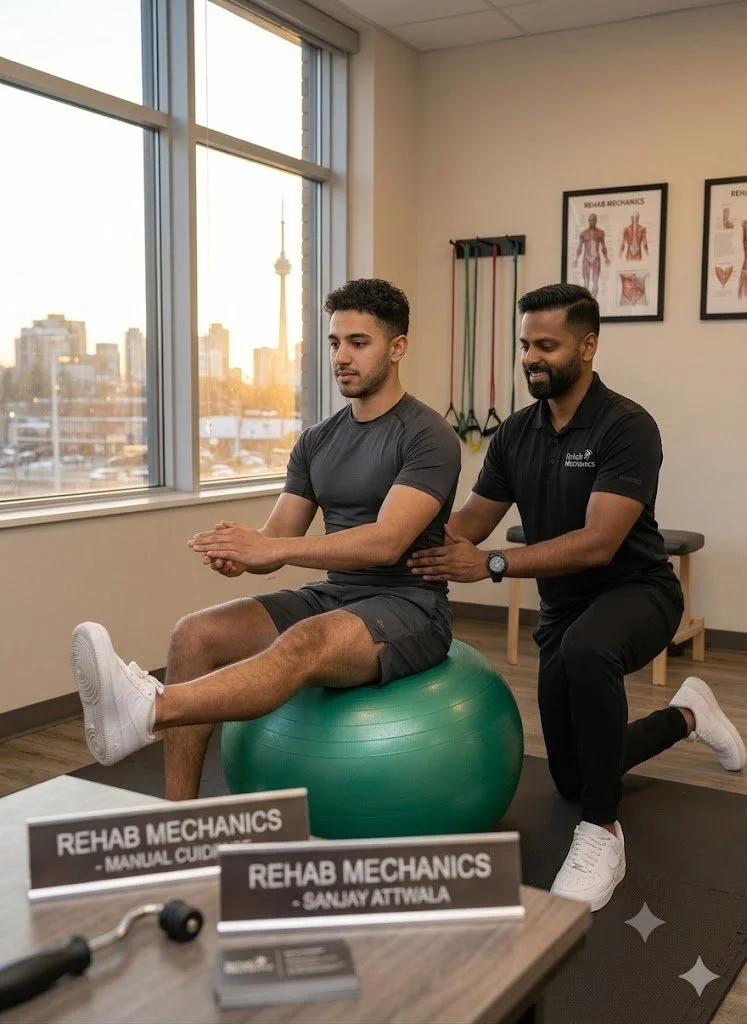
Glute Medius Activation: Utilizing highly isolated, side-lying movements (like clam shells with resistance bands and strict hip abductions). We use tactile feedback to ensure you are firing the glute and not compensating with the lower back.
Isometric Loading: Using heavy, static holds against the wall to train the gluteus medius to contract continuously, simulating the sustained effort required during a long run.
Phase 3: Dynamic Pelvic Control and Gait Retraining (Weeks 6-10)
Strength on a treatment table means nothing if it doesn't translate to the pavement.
Closed Kinetic Chain Integration: We progress to dynamic step-downs, single-leg deadlifts, and lateral lunges. We meticulously monitor your knee tracking to ensure the glute fires instantly, preventing the femur from rotating inward.
Cadence Manipulation: We may analyze your running gait on a treadmill. Increasing your step rate (cadence) by just 5% to 10% drastically reduces the impact force and limits the amount of time the pelvis has to drop, providing massive relief to the outer knee.
Run Without Limits
You do not have to abandon your marathon goals or suffer through agonizing foam rolling sessions. By correcting the structural biomechanics of your pelvis and hips, you can permanently eliminate the compressive forces causing your knee pain.
Book a comprehensive sports biomechanics assessment with our clinical team today. We are conveniently located inside the Prime Medical Centre at 68 Abell Street, offering elite running rehabilitation in Toronto Queen West.
Contact us to schedule your appointment:
Email: info@rehabmechanics.com
Phone: (416) 533-3900
About the Author
Mr. Sanjay Attwala (B.Sc., M.Sc., RPT) is a Registered Physiotherapist, clinical director, and the founder of Rehab Mechanics in Toronto. With over 15 years of registered clinical practice and a deep specialization in complex musculoskeletal rehabilitation, Sanjay synthesizes rigorous international academic training with advanced evidence-based therapeutics to guide his clinical practice and patient education initiatives.
Academic Background & Credentials
Master of Science (M.Sc.) in Physiotherapy – University of Keele, United Kingdom (2010).
Bachelor of Science (B.Sc.) – University of Waterloo, Ontario, Canada.
Registered Physiotherapist (RPT) – Regulated health professional in excellent standing with the College of Physiotherapists of Ontario (CPO).
Corporate Entity – Operating officially under the S. Attwala Physiotherapy Professional Corporation with a DBA of Rehab Mechanics.
Clinical Expertise & Philosophy
Sanjay’s clinical approach rejects passive symptom management in favor of identifying underlying biomechanical root causes. His diverse expertise spans advanced manual therapies, personalized corrective exercise prescription, and modern physical modalities. At the Rehab Mechanics Toronto Queen West clinic, he routinely diagnoses and treats complex conditions including:
Spinal & Discogenic Pathology – Cervical, thoracic, and lumbar disc injuries, sciatica, and sacroiliac joint (SIJ) dysfunction.
Upper & Lower Extremity Injuries – Rotator cuff tears, frozen shoulder, tennis/golfer’s elbow, carpal tunnel syndrome, and complex ankle/foot pathologies.
Perinatal & Pelvic Health Rehabilitation – Specialized assessment and rehabilitation protocols tailored specifically for women during pregnancy and the post-partum period, addressing pelvic girdle pain, diastasis recti, and core stabilization.
Specialized Rehabilitation – Pelvic health therapy, TMJ dysfunction, post-surgical rehabilitation (including Total Hip and Total Knee Replacements), and custom orthotics dispensing.
Shockwave Therapy: with advanced cutting edge technological devices to suit your needs.
Interdisciplinary Practice & Patient Care
Sanjay practices an integrated model of healthcare, working closely alongside medical doctors inside the Prime Medical Centre on Abell Street to streamline patient recovery pathways. He maintains a human-centric, communication-first clinical framework, ensuring that care remains fully customized rather than automated.
His clinical caseload encompasses a broad operational spectrum under Ontario's regulatory frameworks, including:
Motor Vehicle Accident (MVA) Claims – Rehabilitation navigating Ontario’s statutory accident benefits schedule.
Workplace Safety and Insurance Board (WSIB) – Occupational injury management and return-to-work screening.
Extended Health Care (EHC) & Private Practice – Multi-tier insurance coordination and long-term athletic development plans.
Commitment to Research & Community
Outside of his clinical caseload at Rehab Mechanics and his additional practice affiliations in Etobicoke, Sanjay is an active health writer and community educator. He translates contemporary peer-reviewed medical research into accessible, actionable guidance on his professional blog. As a dedicated father and husband, he mirrors his professional advice in his personal life, focusing on structural mobility, cross-training, and longevity to help his family and his community thrive. Naturally he takes he a keen interest in rehabilitation for women who are pregnant and post-partum.
Disclaimer: The information provided on this blog is intended for educational and informational purposes only. It does not constitute medical advice, diagnosis, or a treatment plan. Always seek the direct advice of a Registered Physiotherapist, physician, or other qualified health provider regarding any medical condition or physical rehabilitation routine.