Can Pelvic Floor Physiotherapy Cure Urinary Leakage When Running?
Yes. Pelvic floor physiotherapy effectively cures stress urinary incontinence. By utilizing targeted neuromuscular re-education, diaphragmatic breathing integration, and progressive internal strengthening, physiotherapy restores the structural integrity of the pelvic floor, eliminating leakage without the need for invasive surgical mesh procedures.
The Silent Struggle of the Active Urban Woman
Toronto is a city that moves. From high-intensity interval training (HIIT) classes in Liberty Village to weekend running groups tackling the Martin Goodman Trail, women in this city prioritize their health and fitness. However, there is a pervasive, silent barrier that forces many women to abandon the activities they love: Stress Urinary Incontinence (SUI).
Whether you are a post-partum mother trying to return to CrossFit or a woman who has simply noticed a sudden, embarrassing leak when sneezing, coughing, or performing jumping jacks, the psychological toll is immense. Women often silently alter their lives—wearing dark leggings, mapping out every bathroom on their running route, or quitting high-impact sports entirely.
The prevailing, outdated medical advice is often "just do your Kegels" or, worse, to simply accept leakage as a "normal" part of aging or motherhood. At Rehab Mechanics in Queen West, our specialized Perinatal & Pelvic Health program categorically rejects this notion. Leaking is common, but it is never normal. It is a biomechanical failure of the pelvic floor, and through advanced, specialized physiotherapy, it is highly curable.
Structural Analysis: The Biomechanics of the Pelvic Floor
To permanently cure incontinence, we must look far beyond generic "Kegel" exercises. We must perform a rigorous structural analysis of your deep core mechanics.
The Anatomy of the Pelvic Sling
Your pelvic floor is not a single muscle. It is a complex, hammock-like sling comprising 14 different muscles, fascia, and thick connective tissues that stretch from your pubic bone in the front to your tailbone (sacrum) in the back.
The Sphincteric Function: These muscles physically wrap around your urethra, vagina, and rectum. When they contract, they kink these tubes shut, preventing the involuntary loss of urine or feces.
The Supportive Function: They act as the literal floor of your abdominal cavity, holding up your bladder, uterus, and bowels against the constant, downward pull of gravity.
The Mechanics of Intra-Abdominal Pressure (IAP)
Your core operates like a pressurized soda can.
The Roof: Your respiratory diaphragm.
The Walls: Your deep abdominal muscles (transversus abdominis).
The Floor: Your pelvic floor muscles.
The "Pressure Leak" Concept
Every time you run, jump, cough, or lift a heavy barbell, the pressure inside this "soda can" skyrockets.
The Biomechanical Failure
If your pelvic floor muscles are weak, overly tight, or uncoordinated, they cannot withstand this sudden spike in pressure. The downward force overwhelms the urethral sphincter, and a leak occurs. This is the exact definition of Stress Urinary Incontinence.
Why Generic Kegels Fail
A "Kegel" is simply a concentric contraction of the pelvic floor. For many women, doing more Kegels actually makes the problem worse.
Hypertonic (Overactive) Pelvic Floors: Many high-achieving, stressed urban professionals unconsciously clench their pelvic floors all day long (similar to clenching the jaw).
The Rubber Band Analogy: A muscle that is constantly clenched is exhausted and short. If you try to stretch a rubber band that is already pulled tight, it snaps. If your pelvic floor is already spasming, it cannot contract any further when you jump, leading to immediate leakage.
The Clinical Reality: In these cases, the treatment is not strengthening; the treatment is lengthening and releasing the pelvic floor before any strengthening can safely occur.
Primary Source Proof: Efficacy of Pelvic Rehabilitation
Clinical guidelines universally mandate that specialized, physiotherapist-guided pelvic floor muscle training must be the absolute first line of treatment for urinary incontinence, outperforming pharmacological and surgical interventions in long-term safety and efficacy.
Download Clinical Efficacy PDF: The Efficacy of Pelvic Floor Muscle Training in the Conservative Management of Stress Urinary Incontinence (Open Access Medical Review)
Note: The link above serves as an example of our commitment to evidence-based practice, referencing standard international clinical guidelines for pelvic health rehabilitation.
The Rehab Mechanics Pelvic Floor Protocol
Our specialized pelvic health physiotherapists utilize a highly discreet, trauma-informed, and scientifically phased approach to restoring your core mechanics.
Phase 1: Advanced Diagnostics and Internal Assessment
We do not guess what your pelvic floor is doing; we accurately assess it.
The Internal Exam: With your strict consent, a specially trained physiotherapist performs an internal vaginal examination. This is the only way to accurately assess the resting tone, strength, endurance, and fascial restrictions of the pelvic sling.
Neurological Screening: Ensuring that the nerves supplying the bladder and pelvic floor are firing correctly.
Diaphragmatic Assessment: Evaluating how your breathing patterns impact your pelvic floor tension.
Phase 2: Down-Training and Myofascial Release (Weeks 1-4)
If your pelvic floor is hypertonic (too tight), we must release the brakes.
Internal Trigger Point Release: Applying gentle, targeted pressure to painful knots within the pelvic floor muscles to stop chronic spasms.
360-Degree Breathing Integration: Re-training your diaphragm to expand outward into your ribs, rather than bearing down heavily on your bladder.
Fascial Lengthening: Teaching you specific, deep squatting and mobility exercises designed to open the bony pelvis and stretch the deep connective tissues.
Phase 3: Neuromuscular Up-Training (Weeks 4-8)
Once the muscles are supple, we build their strength and timing.
The "Knack" Technique: Teaching your nervous system to automatically pre-contract the pelvic floor milliseconds before a cough, sneeze, or jump to proactively counter the pressure spike.
Eccentric Loading: The pelvic floor must be able to stretch safely while under load (eccentric control) to absorb the shock of running. We use specific dynamic movements to train this elastic recoil.
Core Co-Contraction: Integrating the transversus abdominis with the pelvic floor so they fire simultaneously as a unified, supportive wall.
Phase 4: High-Impact Functional Simulation (Weeks 8+)
We simulate your specific athletic demands inside the clinic.
Plyometric Integration: We progress from slow lifts to rapid movements—like jumping rope, box jumps, and heavy deadlifts—while monitoring your intra-abdominal pressure management.
Return-to-Run Programming: Designing a structured, graduated running protocol that safely increases your pavement mileage without triggering a relapse of leakage or pelvic heaviness.
Reclaim Your Active Life
You do not have to accept urinary leakage as your new normal. You deserve to run, jump, laugh, and lift without fear or embarrassment.
Book a highly confidential, comprehensive pelvic health assessment with our specialized clinical team today. We are conveniently located inside the Prime Medical Centre at 68 Abell Street, offering elite, private care in the heart of Queen West.
Contact us to schedule your appointment:
Email: info@rehabmechanics.com
Phone: (416) 533-3900
About the Author
Mr. Sanjay Attwala (B.Sc., M.Sc., RPT) is a Registered Physiotherapist, clinical director, and the founder of Rehab Mechanics in Toronto. With over 15 years of registered clinical practice and a deep specialization in complex musculoskeletal rehabilitation, Sanjay synthesizes rigorous international academic training with advanced evidence-based therapeutics to guide his clinical practice and patient education initiatives.
Academic Background & Credentials
Master of Science (M.Sc.) in Physiotherapy – University of Keele, United Kingdom (2010).
Bachelor of Science (B.Sc.) – University of Waterloo, Ontario, Canada.
Registered Physiotherapist (RPT) – Regulated health professional in excellent standing with the College of Physiotherapists of Ontario (CPO).
Corporate Entity – Operating officially under the S. Attwala Physiotherapy Professional Corporation with a DBA of Rehab Mechanics.
Clinical Expertise & Philosophy
Sanjay’s clinical approach rejects passive symptom management in favor of identifying underlying biomechanical root causes. His diverse expertise spans advanced manual therapies, personalized corrective exercise prescription, and modern physical modalities. At the Rehab Mechanics Toronto Queen West clinic, he routinely diagnoses and treats complex conditions including:
Spinal & Discogenic Pathology – Cervical, thoracic, and lumbar disc injuries, sciatica, and sacroiliac joint (SIJ) dysfunction.
Upper & Lower Extremity Injuries – Rotator cuff tears, frozen shoulder, tennis/golfer’s elbow, carpal tunnel syndrome, and complex ankle/foot pathologies.
Perinatal & Pelvic Health Rehabilitation – Specialized assessment and rehabilitation protocols tailored specifically for women during pregnancy and the post-partum period, addressing pelvic girdle pain, diastasis recti, and core stabilization.
Specialized Rehabilitation – Pelvic health therapy, TMJ dysfunction, post-surgical rehabilitation (including Total Hip and Total Knee Replacements), and custom orthotics dispensing.
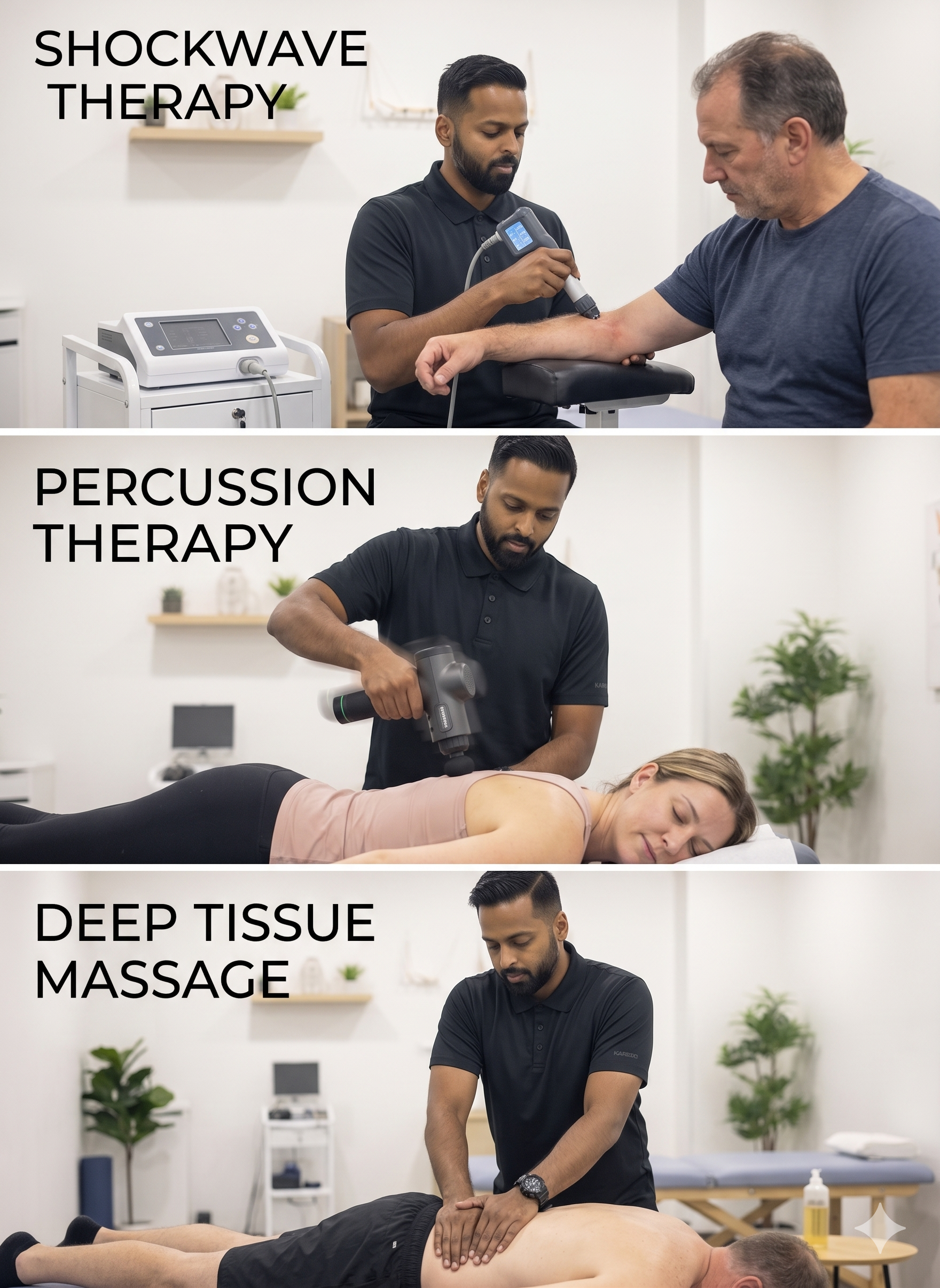
Shockwave Therapy: with advanced cutting edge technological devices to suit your needs.
Interdisciplinary Practice & Patient Care
Sanjay practices an integrated model of healthcare, working closely alongside medical doctors inside the Prime Medical Centre on Abell Street to streamline patient recovery pathways. He maintains a human-centric, communication-first clinical framework, ensuring that care remains fully customized rather than automated.
His clinical caseload encompasses a broad operational spectrum under Ontario's regulatory frameworks, including:
Motor Vehicle Accident (MVA) Claims – Rehabilitation navigating Ontario’s statutory accident benefits schedule.
Workplace Safety and Insurance Board (WSIB) – Occupational injury management and return-to-work screening.
Extended Health Care (EHC) & Private Practice – Multi-tier insurance coordination and long-term athletic development plans.
Commitment to Research & Community
Outside of his clinical caseload at Rehab Mechanics and his additional practice affiliations in Etobicoke, Sanjay is an active health writer and community educator. He translates contemporary peer-reviewed medical research into accessible, actionable guidance on his professional blog. As a dedicated father and husband, he mirrors his professional advice in his personal life, focusing on structural mobility, cross-training, and longevity to help his family and his community thrive. Naturally he takes he a keen interest in rehabilitation for women who are pregnant and post-partum.
Disclaimer: The information provided on this blog is intended for educational and informational purposes only. It does not constitute medical advice, diagnosis, or a treatment plan. Always seek the direct advice of a Registered Physiotherapist, physician, or other qualified health provider regarding any medical condition or physical rehabilitation routine.