Can Physiotherapy Fix Shoulder Impingement Without Surgery?
Yes. Physiotherapy is the most effective treatment for shoulder impingement syndrome. By correcting scapular dyskinesis, restoring thoracic mobility, and strengthening the rotator cuff to hold the arm bone perfectly centralized in the socket, physiotherapy physically eliminates the friction causing your pain.
The Overhead "Catch"
For the active demographic in Queen West, your shoulder is your most important tool. Whether you are lifting a heavy barbell in the gym, playing a recreational tennis match, or reaching overhead to grab a high shelf in your apartment, the shoulder must move with fluid, frictionless precision.
When you start to feel a sharp, stabbing "catch" or "pinch" in the front of your shoulder whenever you lift your arm above head height, it is a sign that your shoulder is not moving correctly. The medical term is Shoulder Impingement Syndrome. It is incredibly common, often dismissed as "just a strain," and frequently managed incorrectly with ice and rest.
At Rehab Mechanics, we see patients who have lived with this impingement for years. They worry they have a "torn rotator cuff" and fear surgery. The reality is often much simpler: your shoulder blade is not moving in sync with your arm bone. By correcting this mechanical timing, we can eliminate the pinch immediately and prevent the development of a chronic rotator cuff tear.
Structural Analysis: The Mechanics of Impingement
To understand why your shoulder pinches, we must look at the "subacromial tunnel"—the narrow, bony bottleneck through which your tendons must travel.
The Subacromial Bottleneck
Your shoulder joint is a ball-and-socket, but the "socket" is roofed by a bony prominence called the acromion.
The Tunnel: Between the ball (the arm bone) and the roof (the acromion) is a narrow, tunnel-like space.
The Contents: Through this tunnel pass your vital rotator cuff tendons and a fluid-filled sac called the subacromial bursa.
The "Crush" Mechanism (Impingement)
In a healthy shoulder, your rotator cuff muscles pull the ball of the arm bone downward, keeping it low in the socket as you lift your arm. This keeps the tunnel wide and open.
The Breakdown: If your rotator cuff is weak, or if your shoulder blade (scapula) is stiff, the arm bone slides upward too early during the lift.
The Impingement: The top of the arm bone smashes into the roof of the tunnel (the acromion). This physically crushes the rotator cuff tendon and the bursa against the bone.
The Result: Sharp, blinding pain, often followed by a dull, throbbing ache that lasts for hours after the lift.
Primary Source Proof: Impingement Rehabilitation
Sports medicine research conclusively mandates that physiotherapy is the first-line treatment for shoulder impingement, often achieving superior long-term results compared to surgical decompression.
Download Clinical Efficacy PDF: The Efficacy of Conservative Physical Therapy versus Surgical Decompression in Shoulder Impingement Syndrome (Open Access Medical Review)
The Rehab Mechanics Corrective Protocol
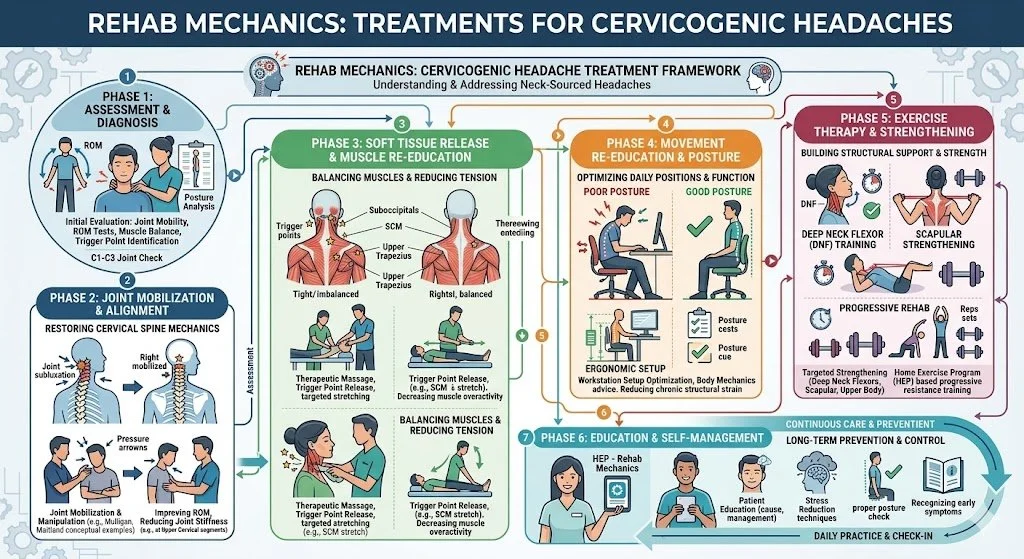
We treat impingement not by massaging the painful spot, but by fixing the biomechanics of the entire shoulder girdle.
Phase 1: Decompressing the Tunnel
We must stop the bone-on-bone grinding immediately.
Posterior Capsule Mobilization: A stiff back-of-the-shoulder capsule pushes the arm bone forward into the impingement zone. Our therapists use high-grade manual glides to loosen this tissue.
Manual Release of the Pectoralis Minor: A tight chest muscle physically drags the shoulder blade into a forward tilt, narrowing the subacromial tunnel. We release this tension to restore scapular alignment.
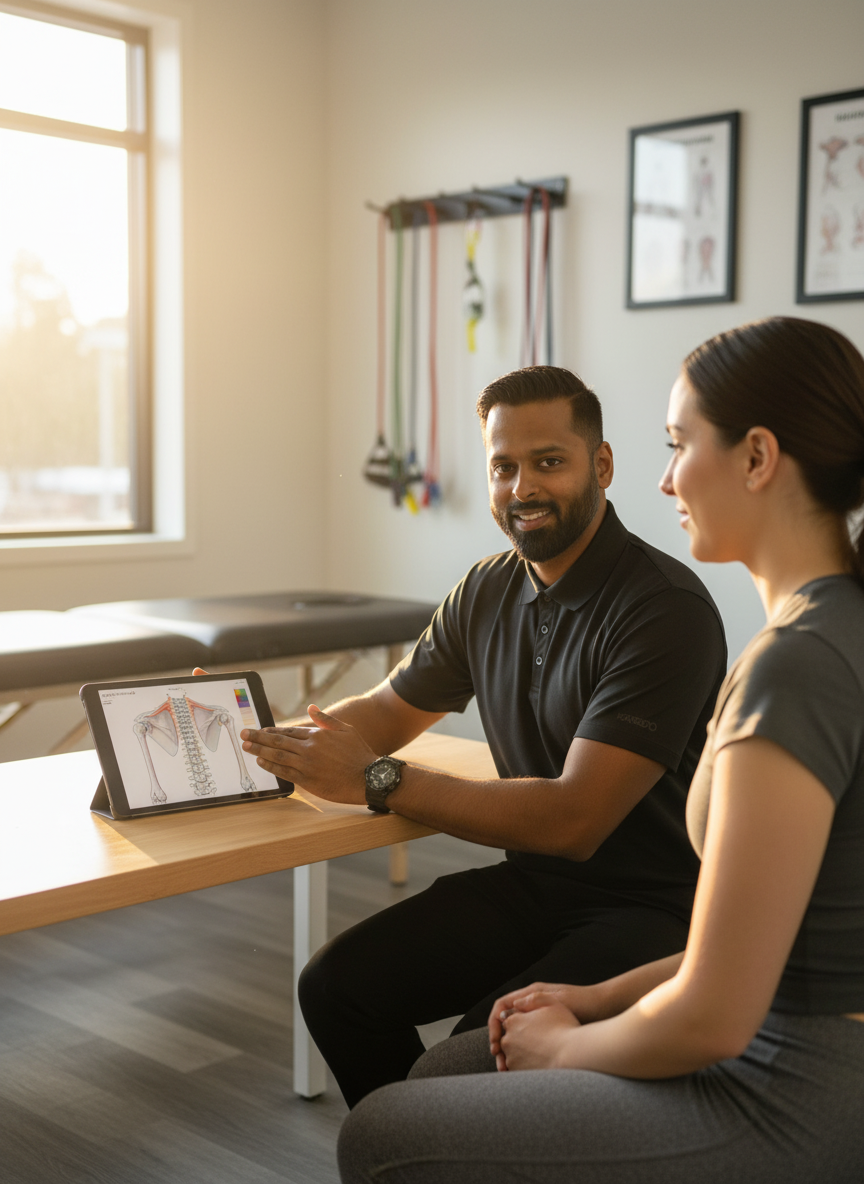
Phase 2: Restoring Scapulothoracic Rhythm
We must teach your shoulder blade how to get out of the way of your arm bone.
Lower Trapezius and Serratus Anterior Activation: These muscles pull the shoulder blade down and back, physically opening the tunnel. We use targeted resistance work to ensure these muscles fire automatically during overhead movements.
Neuromuscular Re-education: We use tactical cueing to retrain the brain to keep the shoulder blade "set" firmly against the ribcage as you lift, preventing the "hike-and-hunch" compensation pattern.
Phase 3: Rotator Cuff Fortification
Once the joint is mechanically safe, we build the strength to hold the ball centered in the socket.
Eccentric Rotator Cuff Loading: Using targeted resistance training to rebuild the tendons. A strong rotator cuff is the only structural guarantee that the arm bone stays centralized in the socket, permanently preventing impingement.
Reclaim Your Overhead Power
Stop letting a pinching shoulder limit your training or your daily life. Fix the mechanics, and the pain disappears.
Book your comprehensive shoulder assessment with our clinical team today. We are conveniently located inside the Prime Medical Centre at 68 Abell Street, offering elite orthopedic recovery in Toronto.
Contact us to schedule your appointment:
Email: info@rehabmechanics.com
Phone: (416) 533-3900
About the Author
Mr. Sanjay Attwala (B.Sc., M.Sc., RPT) is a Registered Physiotherapist, clinical director, and the founder of Rehab Mechanics in Toronto. With over 15 years of registered clinical practice and a deep specialization in complex musculoskeletal rehabilitation, Sanjay synthesizes rigorous international academic training with advanced evidence-based therapeutics to guide his clinical practice and patient education initiatives.
Academic Background & Credentials
Master of Science (M.Sc.) in Physiotherapy – University of Keele, United Kingdom (2010).
Bachelor of Science (B.Sc.) – University of Waterloo, Ontario, Canada.
Registered Physiotherapist (RPT) – Regulated health professional in excellent standing with the College of Physiotherapists of Ontario (CPO).
Corporate Entity – Operating officially under the S. Attwala Physiotherapy Professional Corporation with a DBA of Rehab Mechanics.
Clinical Expertise & Philosophy
Sanjay’s clinical approach rejects passive symptom management in favor of identifying underlying biomechanical root causes. His diverse expertise spans advanced manual therapies, personalized corrective exercise prescription, and modern physical modalities. At the Rehab Mechanics Toronto Queen West clinic, he routinely diagnoses and treats complex conditions including:
Spinal & Discogenic Pathology – Cervical, thoracic, and lumbar disc injuries, sciatica, and sacroiliac joint (SIJ) dysfunction.
Upper & Lower Extremity Injuries – Rotator cuff tears, frozen shoulder, tennis/golfer’s elbow, carpal tunnel syndrome, and complex ankle/foot pathologies.
Perinatal & Pelvic Health Rehabilitation – Specialized assessment and rehabilitation protocols tailored specifically for women during pregnancy and the post-partum period, addressing pelvic girdle pain, diastasis recti, and core stabilization.
Specialized Rehabilitation – Pelvic health therapy, TMJ dysfunction, post-surgical rehabilitation (including Total Hip and Total Knee Replacements), and custom orthotics dispensing.
Shockwave Therapy: with advanced cutting edge technological devices to suit your needs.
Interdisciplinary Practice & Patient Care
Sanjay practices an integrated model of healthcare, working closely alongside medical doctors inside the Prime Medical Centre on Abell Street to streamline patient recovery pathways. He maintains a human-centric, communication-first clinical framework, ensuring that care remains fully customized rather than automated.
His clinical caseload encompasses a broad operational spectrum under Ontario's regulatory frameworks, including:
Motor Vehicle Accident (MVA) Claims – Rehabilitation navigating Ontario’s statutory accident benefits schedule.
Workplace Safety and Insurance Board (WSIB) – Occupational injury management and return-to-work screening.
Extended Health Care (EHC) & Private Practice – Multi-tier insurance coordination and long-term athletic development plans.
Commitment to Research & Community
Outside of his clinical caseload at Rehab Mechanics and his additional practice affiliations in Etobicoke, Sanjay is an active health writer and community educator. As a dedicated father and husband, he mirrors his professional advice in his personal life, focusing on structural mobility, cross-training, and longevity to help his family and his community thrive. Naturally he takes he a keen interest in rehabilitation for women who are pregnant and post-partum.
Disclaimer: The information provided on this blog is intended for educational and informational purposes only. It does not constitute medical advice, diagnosis, or a treatment plan. Always seek the direct advice of a Registered Physiotherapist, physician, or other qualified health provider regarding any medical condition or physical rehabilitation routine.