Does Physiotherapy Actually Help Severe Lumbar Spinal Stenosis?
Yes. Physiotherapy provides profound relief for lumbar spinal stenosis. By restoring specific spinal flexion mechanics, decompressing the narrowed nerve canals, and fortifying the deep core stabilizers, physiotherapy eliminates neurogenic leg heaviness and dramatically improves walking capacity without invasive spinal surgery.
The Frustration of the "Shopping Cart" Lean
Toronto is a highly walkable city. From strolling through Trinity Bellwoods to navigating the grocery aisles in Liberty Village, the ability to walk comfortably is central to urban independence.
However, for many older adults and individuals with advanced spinal wear-and-tear, walking more than five minutes triggers a devastating symptom profile: a deep, cramping heaviness in both legs, numbness in the calves, and severe, aching lower back pain.
Strangely, the moment these patients sit down on a park bench or lean heavily forward on a shopping cart, the pain vanishes almost instantly. This highly specific presentation is the classic hallmark of Lumbar Spinal Stenosis, a condition characterized by neurogenic claudication.
Patients are frequently told that their spine is "crumbling" and that major spinal fusion or laminectomy surgery is inevitable. At Rehab Mechanics, our advanced spinal pathology programs prove otherwise. We utilize precise, biomechanical decompression techniques and targeted neuromuscular control to physically widen the space for your nerves, keeping you upright, walking, and out of the operating room.
Structural Analysis: The Mechanics of Spinal Crowding
To effectively treat spinal stenosis, we must perform a deep anatomical analysis of the lumbar spine and exactly why the nerves are suffocating.
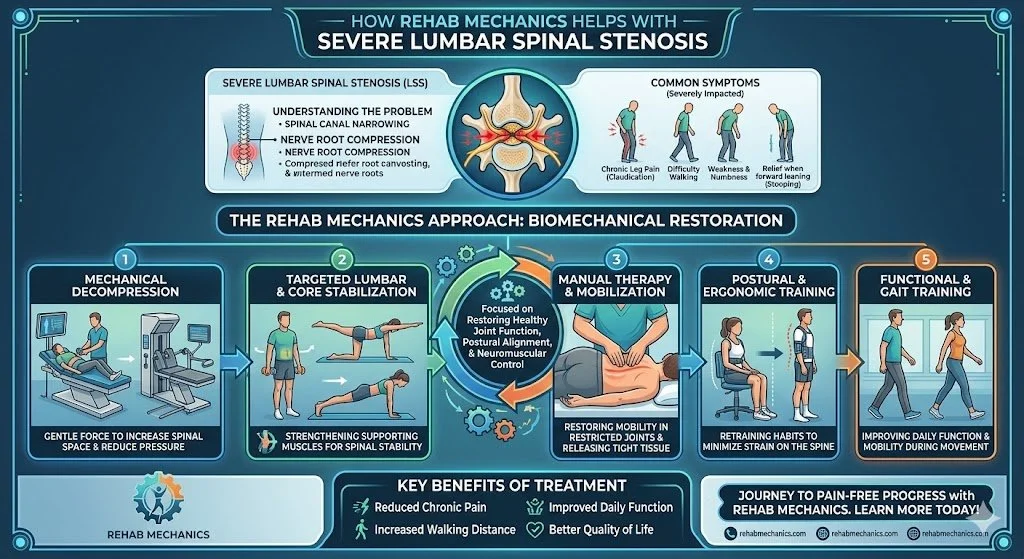
Anatomy of the Spinal Canal
Your spinal cord and nerve roots travel down your back through a central hollow tube (the spinal canal) and exit out the sides of the spine through tiny bony holes called the neural foramina.
The Stenotic Cascade
Spinal stenosis literally means "narrowing of the spine." It is a degenerative cascade that shrinks these essential spaces.
Disc Degeneration: As we age, the shock-absorbing discs between our vertebrae lose water height and flatten out.
Facet Joint Hypertrophy: Because the discs are flat, the tiny joints at the back of the spine (facet joints) absorb excessive friction. They develop severe osteoarthritis and grow massive, jagged bone spurs (osteophytes) that protrude directly into the nerve canals.
Ligamentum Flavum Thickening: A thick ligament runs down the inside of the spinal canal to provide stability. In stenosis, this ligament buckles and massively thickens, violently choking the spinal cord from behind.
Neurogenic Claudication (Why Walking Hurts)
The hallmark symptom of stenosis is neurogenic claudication—the cramping and severe leg heaviness that only happens when you walk or stand up straight.
The Postural Trigger (Extension vs. Flexion)
Extension (Standing Up): When you stand perfectly straight or walk, your lumbar spine naturally arches backward (lumbar extension). This physical movement completely closes down the already-crowded spinal canal and neural foramina, instantly pinching the nerves and cutting off their blood supply.
Flexion (Leaning Forward): When you sit down or lean forward on a shopping cart, your spine rounds forward (lumbar flexion). This mechanically opens the spinal canal by up to 20%, instantly relieving the nerve strangulation and allowing the leg pain to vanish.
Primary Source Proof: Non-Operative Decompression
Orthopedic and neurosurgical guidelines strongly advocate for specific, flexion-biased physical therapy and manual decompression as the absolute first-line treatment for lumbar spinal stenosis prior to considering high-risk spinal decompression surgery.
Download Clinical Efficacy PDF: The Efficacy of Manual Therapy and Flexion-Biased Exercise in the Management of Lumbar Spinal Stenosis (Open Access Medical Review)
Note: The link above serves as an example of our commitment to evidence-based practice, referencing standard international clinical guidelines for complex spinal rehabilitation.
The Rehab Mechanics Stenosis Protocol
Treating spinal stenosis is the exact opposite of treating a herniated disc. Generic back extension exercises (like yoga "cobra" poses) will violently aggravate a stenotic spine. We use a highly specialized, flexion-biased biomechanical approach.
Phase 1: Flexion-Biased Decompression
Our immediate goal is to safely create space for the crushed nerves.
Manual Joint Mobilization: Our physiotherapists apply highly specific, targeted pressure (Grade III/IV mobilizations) to the stiff lumbar vertebrae, gently stretching the tight joint capsules to maximize the available space in the neural foramina.
Flexion Stretching: Implementing precise, repeated knee-to-chest and child's pose movements to physically stretch the thickened ligamentum flavum and open the back of the spinal canal, immediately draining the neurological leg pain.
Traction: Utilizing manual, localized traction to decompress the spine and relieve the ischemic (blood-starved) nerve roots.
Phase 2: Pelvic Tilt Neuromuscular Control
Because leaning forward relieves the pain, we must teach your body how to mimic that position subtly while you are standing upright.
Posterior Pelvic Tilts: We rigorously train the deep lower abdominal muscles to rotate your pelvis backward (tucking your tailbone). This flattens the lower back curve slightly, physically keeping the spinal canal open even when you are standing tall.
Hip Flexor Release: Sitting for years causes the hip flexors (psoas) to become rigidly tight. Tight hip flexors aggressively pull the spine forward into an arch (extension). We manually release these muscles to stop them from crushing the spinal canal.
Phase 3: Functional Walking Endurance
We must restore your cardiovascular capacity and walking distance safely.
Stationary Cycling: Because sitting opens the spine, stationary cycling is an incredible way to build leg strength and cardiovascular fitness without triggering neurogenic claudication.
Incline Treadmill Walking: Walking on an uphill incline naturally forces the body to lean slightly forward, opening the spine and allowing patients to rebuild their walking endurance without pain.
Keep Walking Without Pain
Do not let spinal stenosis confine you to a chair or force you into a risky, irreversible spinal fusion. By mastering your pelvic mechanics and manually decompressing the spine, expert physiotherapy can dramatically improve your walking tolerance and eliminate the heavy, cramping pain in your legs.
Book a comprehensive spinal assessment with our specialized clinical team today. We are conveniently located inside the Prime Medical Centre at 68 Abell Street, offering advanced orthopedic and neurological care in Toronto Queen West.
Contact us to schedule your appointment:
Email: info@rehabmechanics.com
Phone: (416) 533-3900
About the Author
Mr. Sanjay Attwala (B.Sc., M.Sc., RPT) is a Registered Physiotherapist, clinical director, and the founder of Rehab Mechanics in Toronto. With over 15 years of registered clinical practice and a deep specialization in complex musculoskeletal rehabilitation, Sanjay synthesizes rigorous international academic training with advanced evidence-based therapeutics to guide his clinical practice and patient education initiatives.
Academic Background & Credentials
Master of Science (M.Sc.) in Physiotherapy – University of Keele, United Kingdom (2010).
Bachelor of Science (B.Sc.) – University of Waterloo, Ontario, Canada.
Registered Physiotherapist (RPT) – Regulated health professional in excellent standing with the College of Physiotherapists of Ontario (CPO).
Corporate Entity – Operating officially under the S. Attwala Physiotherapy Professional Corporation with a DBA of Rehab Mechanics.
Clinical Expertise & Philosophy
Sanjay’s clinical approach rejects passive symptom management in favor of identifying underlying biomechanical root causes. His diverse expertise spans advanced manual therapies, personalized corrective exercise prescription, and modern physical modalities. At the Rehab Mechanics Toronto Queen West clinic, he routinely diagnoses and treats complex conditions including:
Spinal & Discogenic Pathology – Cervical, thoracic, and lumbar disc injuries, sciatica, and sacroiliac joint (SIJ) dysfunction.
Upper & Lower Extremity Injuries – Rotator cuff tears, frozen shoulder, tennis/golfer’s elbow, carpal tunnel syndrome, and complex ankle/foot pathologies.
Perinatal & Pelvic Health Rehabilitation – Specialized assessment and rehabilitation protocols tailored specifically for women during pregnancy and the post-partum period, addressing pelvic girdle pain, diastasis recti, and core stabilization.
Specialized Rehabilitation – Pelvic health therapy, TMJ dysfunction, post-surgical rehabilitation (including Total Hip and Total Knee Replacements), and custom orthotics dispensing.
Shockwave Therapy: with advanced cutting edge technological devices to suit your needs.
Interdisciplinary Practice & Patient Care
Sanjay practices an integrated model of healthcare, working closely alongside medical doctors inside the Prime Medical Centre on Abell Street to streamline patient recovery pathways. He maintains a human-centric, communication-first clinical framework, ensuring that care remains fully customized rather than automated.
His clinical caseload encompasses a broad operational spectrum under Ontario's regulatory frameworks, including:
Motor Vehicle Accident (MVA) Claims – Rehabilitation navigating Ontario’s statutory accident benefits schedule.
Workplace Safety and Insurance Board (WSIB) – Occupational injury management and return-to-work screening.
Extended Health Care (EHC) & Private Practice – Multi-tier insurance coordination and long-term athletic development plans.
Commitment to Research & Community
Outside of his clinical caseload at Rehab Mechanics and his additional practice affiliations in Etobicoke, Sanjay is an active health writer and community educator. He translates contemporary peer-reviewed medical research into accessible, actionable guidance on his professional blog. As a dedicated father and husband, he mirrors his professional advice in his personal life, focusing on structural mobility, cross-training, and longevity to help his family and his community thrive. Naturally he takes he a keen interest in rehabilitation for women who are pregnant and post-partum.
Disclaimer: The information provided on this blog is intended for educational and informational purposes only. It does not constitute medical advice, diagnosis, or a treatment plan. Always seek the direct advice of a Registered Physiotherapist, physician, or other qualified health provider regarding any medical condition or physical rehabilitation routine.