Should I See a Pelvic Physiotherapist for C-Section Scar Pain?
Yes. You should see a specialized physiotherapist after a C-Section. Advanced scar mobilization and myofascial release prevent rigid pelvic adhesions, restore deep core activation, and eliminate chronic lower back and pelvic pain long after the surgical incision has healed.
The Overlooked Reality of Major Abdominal Surgery
Toronto is a fast-paced city, and the pressure on new mothers to "bounce back" quickly after childbirth is immense. While cesarean sections account for a massive percentage of births, society frequently minimizes the procedure, treating it as a routine delivery rather than what it truly is: major abdominal surgery.
Months, or even years, after a C-section, many mothers living in Queen West and beyond struggle with a profound sense of physical disconnection. They may experience a deep, burning pulling sensation in their lower pelvis when standing up straight, chronic lower back pain, painful intercourse, or a visible "shelf" of tissue hanging over their scar.
The standard medical follow-up at six weeks post-partum usually consists of a physician checking the surface incision to ensure it isn't infected. Once the skin is closed, mothers are often cleared for all exercise. But skin healing is not tissue rehabilitation. At Rehab Mechanics, our highly specialized Perinatal & Pelvic Health program structurally treats the deep fascial trauma of a C-section, breaking down restrictive adhesions and rebuilding your core from the inside out.
Structural Analysis: The Biomechanics of Surgical Scarring
To understand why a C-section scar can cause massive biomechanical dysfunction throughout your entire body, we must perform a detailed analysis of surgical trauma and the body's fascial network.
The Seven Layers of Incision
A C-section does not just cut the skin. To reach the baby, the surgeon must physically incise or bluntly pull apart seven distinct anatomical layers:
Skin
Subcutaneous fat
Superficial fascia
Rectus sheath (the thick connective tissue holding your abdominal muscles)
Rectus abdominis muscle (separated manually)
Parietal peritoneum
The Uterus
The Healing Process: Fibrotic Adhesions
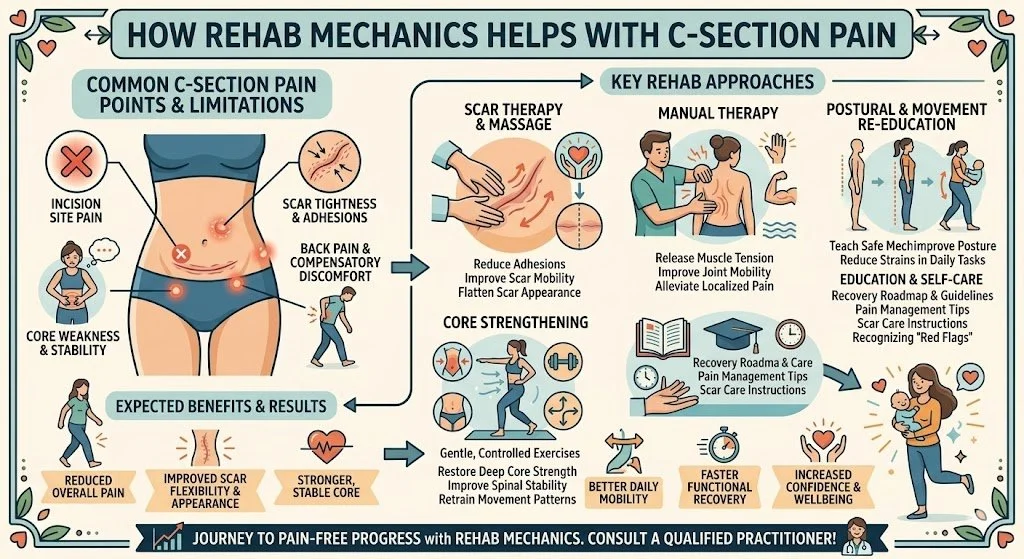
When the body heals these seven layers, it does not heal them individually. It floods the area with inflammatory cells and lays down thick, dense, chaotic collagen fibers (scar tissue) that act like biological glue.
The "Fascial Pull" Effect
This biological glue frequently binds the different layers together—meaning your skin, muscles, and organs can literally become fused into one rigid block of scar tissue. This is known as an adhesion.
The Mechanical Restriction: Fascia is a continuous web of connective tissue that wraps your entire body. When a massive adhesion forms in your lower abdomen, it physically pulls the fascia tight from all directions.
The Downstream Pain: This tight abdominal "knot" forces you to walk slightly hunched forward. This chronic forward pull shuts down your glutes, over-stretches your lower back muscles, and alters the angle of your pelvis, leading to severe, chronic sacroiliac (SIJ) and lumbar spine pain.
The "Shelf" Effect
When the deep fascial layers are bound down tightly to the pubic bone, the healthy tissue and fat above the scar bulge outward over the restriction, creating the classic "C-section shelf." This is a structural mobility issue, not a weight issue.
Primary Source Proof: Post-Partum Rehabilitation
Clinical guidelines in perinatal health heavily mandate specialized, physiotherapist-guided myofascial release and deep core rehabilitation as the primary intervention for resolving post-cesarean pain and functional limitation.
Download Clinical Efficacy PDF: The Efficacy of Soft Tissue Mobilization and Core Rehabilitation Following Cesarean Section (Open Access Medical Review)
Note: The link above serves as an example of our commitment to evidence-based practice, referencing standard international clinical guidelines for post-partum and pelvic health rehabilitation.
The Rehab Mechanics Post-Op Protocol
Healing a C-section requires a trauma-informed, deeply specialized approach. We cannot just perform generic core exercises; we must physically un-bind the trapped tissue.
Phase 1: Deep Scar Mobilization and Desensitization
We must break the rigid adhesions holding your tissue hostage.
Myofascial Release: Once the incision is fully healed (typically past 6-8 weeks), our specialized physiotherapists perform deep, multi-directional manual mobilization directly on and around the scar. We gently pull and stretch the tissue to separate the skin from the underlying fascia and muscle.
Neurological Desensitization: Often, the cutaneous nerves surrounding the scar become hyper-sensitive, causing clothes to feel painful against the skin. We use specific tactile desensitization techniques to calm the nervous system.
Phase 2: Transversus Abdominis (TvA) Reactivation
The surgery brutally traumatized the communication between your brain and your deep core.
Neuromuscular Re-education: We utilize real-time tactile feedback and specialized breathing techniques to re-teach your brain how to fire the Transversus Abdominis (your deep biological corset). This must happen before you attempt any planks, crunches, or heavy lifting.
Restoring Intra-Abdominal Pressure: Re-training your diaphragm to coordinate perfectly with your pelvic floor, ensuring that when you cough or lift your baby, the pressure is distributed safely, rather than pushing outward against your vulnerable scar.
Phase 3: Pelvic Floor Integration and Functional Strength
A C-section does not spare the pelvic floor. The weight of a 9-month pregnancy still stretches and strains the pelvic sling.
Pelvic Health Assessment: Evaluating the resting tone of the pelvic floor to ensure the muscles are not locked in chronic protective spasm.
Dynamic Loading: Transitioning into mom-specific functional strength training. We teach you how to properly hinge at the hips, squat, and lift a heavy stroller without placing shear force on your lower back or anterior abdominal wall.
Reclaim Your Core and Comfort
You do not have to live with a painful, tight scar, a disconnected core, or chronic back pain as the permanent "price" of having a C-section. Specialized, gentle, and highly targeted physiotherapy can restore the sliding mobility of your abdominal fascia and rebuild your structural strength.
Book a comprehensive perinatal core and scar assessment with our specialized clinical team today. We are conveniently located inside the Prime Medical Centre at 68 Abell Street, offering accessible, elite care in Queen West.
Contact us to schedule your appointment:
Email: info@rehabmechanics.com
Phone: (416) 533-3900
About the Author
Mr. Sanjay Attwala (B.Sc., M.Sc., RPT) is a Registered Physiotherapist, clinical director, and the founder of Rehab Mechanics in Toronto. With over 15 years of registered clinical practice and a deep specialization in complex musculoskeletal rehabilitation, Sanjay synthesizes rigorous international academic training with advanced evidence-based therapeutics to guide his clinical practice and patient education initiatives.
Academic Background & Credentials
Master of Science (M.Sc.) in Physiotherapy – University of Keele, United Kingdom (2010).
Bachelor of Science (B.Sc.) – University of Waterloo, Ontario, Canada.
Registered Physiotherapist (RPT) – Regulated health professional in excellent standing with the College of Physiotherapists of Ontario (CPO).
Corporate Entity – Operating officially under the S. Attwala Physiotherapy Professional Corporation with a DBA of Rehab Mechanics.
Clinical Expertise & Philosophy
Sanjay’s clinical approach rejects passive symptom management in favor of identifying underlying biomechanical root causes. His diverse expertise spans advanced manual therapies, personalized corrective exercise prescription, and modern physical modalities. At the Rehab Mechanics Toronto Queen West clinic, he routinely diagnoses and treats complex conditions including:
Spinal & Discogenic Pathology – Cervical, thoracic, and lumbar disc injuries, sciatica, and sacroiliac joint (SIJ) dysfunction.
Upper & Lower Extremity Injuries – Rotator cuff tears, frozen shoulder, tennis/golfer’s elbow, carpal tunnel syndrome, and complex ankle/foot pathologies.
Perinatal & Pelvic Health Rehabilitation – Specialized assessment and rehabilitation protocols tailored specifically for women during pregnancy and the post-partum period, addressing pelvic girdle pain, diastasis recti, and core stabilization.
Specialized Rehabilitation – Pelvic health therapy, TMJ dysfunction, post-surgical rehabilitation (including Total Hip and Total Knee Replacements), and custom orthotics dispensing.
Shockwave Therapy: with advanced cutting edge technological devices to suit your needs.
Interdisciplinary Practice & Patient Care
Sanjay practices an integrated model of healthcare, working closely alongside medical doctors inside the Prime Medical Centre on Abell Street to streamline patient recovery pathways. He maintains a human-centric, communication-first clinical framework, ensuring that care remains fully customized rather than automated.
His clinical caseload encompasses a broad operational spectrum under Ontario's regulatory frameworks, including:
Motor Vehicle Accident (MVA) Claims – Rehabilitation navigating Ontario’s statutory accident benefits schedule.
Workplace Safety and Insurance Board (WSIB) – Occupational injury management and return-to-work screening.
Extended Health Care (EHC) & Private Practice – Multi-tier insurance coordination and long-term athletic development plans.
Commitment to Research & Community
Outside of his clinical caseload at Rehab Mechanics and his additional practice affiliations in Etobicoke, Sanjay is an active health writer and community educator. He translates contemporary peer-reviewed medical research into accessible, actionable guidance on his professional blog. As a dedicated father and husband, he mirrors his professional advice in his personal life, focusing on structural mobility, cross-training, and longevity to help his family and his community thrive. Naturally he takes he a keen interest in rehabilitation for women who are pregnant and post-partum.
Disclaimer: The information provided on this blog is intended for educational and informational purposes only. It does not constitute medical advice, diagnosis, or a treatment plan. Always seek the direct advice of a Registered Physiotherapist, physician, or other qualified health provider regarding any medical condition or physical rehabilitation routine.