Does Sharp Pain in the Front of the Shoulder Mean I Tore My Bicep Tendon?
No. Sharp front shoulder pain is most commonly proximal biceps tendinopathy or impingement, not a full tear. Physiotherapy completely resolves this by correcting scapular mechanics, releasing the pectoral fascia, and applying eccentric loading to the biceps tendon to rebuild its structural integrity without surgery.
The Weightlifter's Worst Nightmare
For the dedicated strength athletes, CrossFitters, and recreational tennis players living in Queen West and Liberty Village, shoulder health is paramount. One of the most terrifying, yet incredibly common, injuries in these demographics is a sudden, sharp, burning pain located precisely at the very front of the shoulder joint, radiating slightly down the arm.
The immediate reaction is panic. Patients feel the pain directly over their bicep muscle and instantly assume they have suffered a massive, catastrophic tear of the biceps tendon that will require surgical reattachment. They stop lifting, cancel their tennis matches, and put their arm in a sling.
However, full ruptures of the biceps tendon are quite rare and usually present with a highly visible, deformed "Popeye" muscle bulge. In the vast majority of cases seen at Rehab Mechanics, this sharp, localized pain is Proximal Biceps Tendinopathy. It is an overuse injury caused by faulty shoulder mechanics that are grinding the tendon against the bone. By correcting how your shoulder blade and rotator cuff function, advanced physical therapy can eliminate the friction and permanently heal the tendon.
Structural Analysis: The Mechanics of the Biceps Tendon
To understand how to fix anterior shoulder pain, we must perform a detailed biomechanical analysis of the shoulder joint and the complex route the biceps tendon takes to get there.
The Anatomy of the Long Head of the Biceps (LHB)
Your biceps muscle has two upper attachment points (heads) that connect it to the shoulder. The "short head" attaches safely outside the joint. The "long head" is the troublemaker.
The Bicipital Groove: The Long Head of the Biceps (LHB) tendon must travel up the front of your arm bone (humerus) through a very narrow, bony trench called the bicipital groove.
The Transverse Humeral Ligament: A tight band of tissue straps the tendon down into this groove to keep it from popping out when you move.
The Intra-Articular Journey: Once it passes through the groove, the tendon literally dives inside the shoulder joint capsule to attach to the top of the socket (the labrum).
The Pathology of Friction (Tendinosis)
Because the LHB tendon makes a sharp 90-degree turn over the bone to enter the joint, it is highly susceptible to friction.
The "Victim" of Poor Mechanics
The biceps tendon rarely fails on its own; it fails because the rest of the shoulder stops doing its job.
Rotator Cuff Exhaustion: If your rotator cuff is weak, it cannot hold the ball of the shoulder tightly in the socket. The joint becomes wobbly.
The Biceps Overcompensation: The brain panics and recruits the LHB tendon to act as a secondary stabilizer. The biceps tendon is forced to pull double-duty, clamping down violently to stabilize the shoulder during a heavy bench press or overhead serve.
The Degeneration Cycle
Friction and Shearing: This constant overworking causes the tendon to grind aggressively back and forth within the narrow bicipital groove.
Angiofibroblastic Degeneration: The friction causes microscopic tears. The tendon thickens, swells, and becomes engorged with chaotic scar tissue and sensitive nerve endings. This is tendinosis—a state of cellular decay, not just simple inflammation.
Primary Source Proof: Biceps Tendinopathy Rehabilitation
Orthopedic sports medicine literature confirms that targeted conservative management—focusing on scapular retraining and eccentric tendon loading—is the highly effective gold standard for resolving proximal biceps tendinopathy, rendering surgical tenodesis unnecessary for most patients.
Review the Clinical Evidence on PubMed: Management of Proximal Biceps Tendinopathy (National Library of Medicine)
Note: The link above directs to external, peer-reviewed medical literature demonstrating our commitment to evidence-based practice and international clinical guidelines for upper extremity rehabilitation.
The Rehab Mechanics Corrective Protocol
Treating biceps tendinopathy requires a comprehensive mechanical overhaul of the entire shoulder complex. We do not just massage the front of the arm; we fix the foundation.
Phase 1: Unloading and Pain Modulation (Weeks 1-3)
We must immediately stop the mechanical grinding to let the swollen tendon breathe.
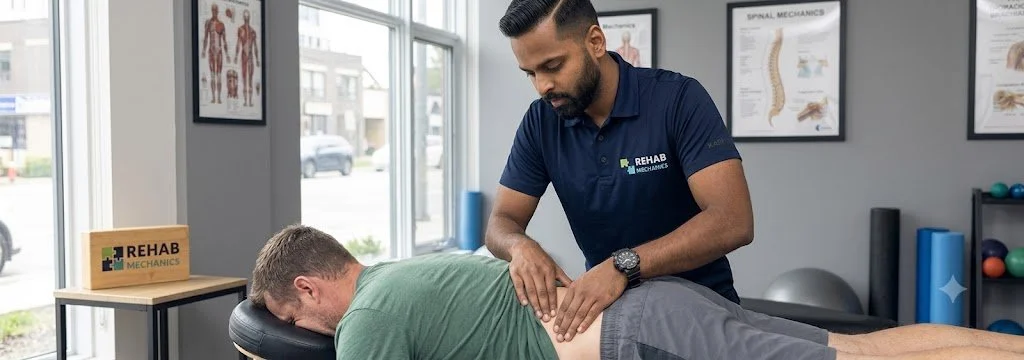
Pectoral and Anterior Deltoid Release: Utilizing advanced manual therapy to strip the tight muscles on the front of the chest. If the shoulders are pulled forward into an internal rotation, the bicipital groove narrows drastically, crushing the tendon.
Activity Modification: Temporarily replacing heavy barbell pressing and overhead throwing with pain-free, neutral-grip exercises to maintain fitness without provoking the tendon.
Joint Mobilization: Our physiotherapists apply gentle posterior glides to the glenohumeral joint to reposition the ball centrally in the socket, taking the mechanical strain off the front of the shoulder.
Phase 2: Scapular and Rotator Cuff Reset (Weeks 4-6)
We must rebuild the primary stabilizers so the biceps tendon can stop overworking.
Lower Trapezius and Serratus Activation: Rebuilding the muscles that anchor the shoulder blade (scapula) to the ribcage. A stable shoulder blade provides a safe, wide clearance for the biceps tendon to move.
Posterior Cuff Fortification: Utilizing targeted resistance band drills to strengthen the infraspinatus and teres minor, forcing the rotator cuff to resume its job of holding the joint stable.
Phase 3: Eccentric Loading and Tendon Remodeling (Weeks 6+)
Once the mechanics are fixed, we must physically rebuild the degenerated biceps tendon.
Heavy Slow Eccentrics: Tendons heal by laying down new collagen under heavy, lengthening tension. We utilize exercises like slow, heavy dumbbell curls, focusing entirely on the 4-second lowering phase. This physically forces the chaotic scar tissue fibers to align perfectly, thickening and bulletproofing the tendon against future tears.
Kinetic Chain Integration: Ensuring that power from the hips and core transfers seamlessly through the shoulder during athletic movements, preventing the arm from absorbing isolated shock.
Stop Fearing a Tear
Do not let sharp, anterior shoulder pain convince you that your lifting or athletic career is over. By addressing the deep mechanical faults in your shoulder and progressively loading the tissue, physical therapy can reverse the tendon degeneration and restore your power.
Book a comprehensive upper extremity assessment with our clinical team today. We are conveniently located inside the Prime Medical Centre at 68 Abell Street, offering elite sports recovery in the heart of Queen West.
Contact us to schedule your appointment:
Email: info@rehabmechanics.com
Phone: (416) 533-3900
About the Author
Mr. Sanjay Attwala (B.Sc., M.Sc., RPT) is a Registered Physiotherapist, clinical director, and the founder of Rehab Mechanics in Toronto. With over 15 years of registered clinical practice and a deep specialization in complex musculoskeletal rehabilitation, Sanjay synthesizes rigorous international academic training with advanced evidence-based therapeutics to guide his clinical practice and patient education initiatives.
Academic Background & Credentials
Master of Science (M.Sc.) in Physiotherapy – University of Keele, United Kingdom (2010).
Bachelor of Science (B.Sc.) – University of Waterloo, Ontario, Canada.
Registered Physiotherapist (RPT) – Regulated health professional in excellent standing with the College of Physiotherapists of Ontario (CPO).
Corporate Entity – Operating officially under the S. Attwala Physiotherapy Professional Corporation with a DBA of Rehab Mechanics.
Clinical Expertise & Philosophy
Sanjay’s clinical approach rejects passive symptom management in favor of identifying underlying biomechanical root causes. His diverse expertise spans advanced manual therapies, personalized corrective exercise prescription, and modern physical modalities. At the Rehab Mechanics Toronto Queen West clinic, he routinely diagnoses and treats complex conditions including:
Spinal & Discogenic Pathology – Cervical, thoracic, and lumbar disc injuries, sciatica, and sacroiliac joint (SIJ) dysfunction.
Upper & Lower Extremity Injuries – Rotator cuff tears, frozen shoulder, tennis/golfer’s elbow, carpal tunnel syndrome, and complex ankle/foot pathologies.
Perinatal & Pelvic Health Rehabilitation – Specialized assessment and rehabilitation protocols tailored specifically for women during pregnancy and the post-partum period, addressing pelvic girdle pain, diastasis recti, and core stabilization.
Specialized Rehabilitation – Pelvic health therapy, TMJ dysfunction, post-surgical rehabilitation (including Total Hip and Total Knee Replacements), and custom orthotics dispensing.
Shockwave Therapy: with advanced cutting edge technological devices to suit your needs.
Interdisciplinary Practice & Patient Care
Sanjay practices an integrated model of healthcare, working closely alongside medical doctors inside the Prime Medical Centre on Abell Street to streamline patient recovery pathways. He maintains a human-centric, communication-first clinical framework, ensuring that care remains fully customized rather than automated.
His clinical caseload encompasses a broad operational spectrum under Ontario's regulatory frameworks, including:
Motor Vehicle Accident (MVA) Claims – Rehabilitation navigating Ontario’s statutory accident benefits schedule.
Workplace Safety and Insurance Board (WSIB) – Occupational injury management and return-to-work screening.
Extended Health Care (EHC) & Private Practice – Multi-tier insurance coordination and long-term athletic development plans.
Commitment to Research & Community
Outside of his clinical caseload at Rehab Mechanics and his additional practice affiliations in Etobicoke, Sanjay is an active health writer and community educator. He translates contemporary peer-reviewed medical research into accessible, actionable guidance on his professional blog. As a dedicated father and husband, he mirrors his professional advice in his personal life, focusing on structural mobility, cross-training, and longevity to help his family and his community thrive. Naturally he takes he a keen interest in rehabilitation for women who are pregnant and post-partum.
Disclaimer: The information provided on this blog is intended for educational and informational purposes only. It does not constitute medical advice, diagnosis, or a treatment plan. Always seek the direct advice of a Registered Physiotherapist, physician, or other qualified health provider regarding any medical condition or physical rehabilitation routine.