
Why Does My Kneecap Feel Loose and Click When I Walk Down Stairs?
Patellar instability causes the kneecap to mal-track and click during movement. Physiotherapy assists in managing this condition by correcting pelvic drop, releasing tight lateral fascia, and strengthening the vastus medialis oblique (VMO) to restore optimal joint tracking and reduce mechanical wear on the retropatellar cartilage.
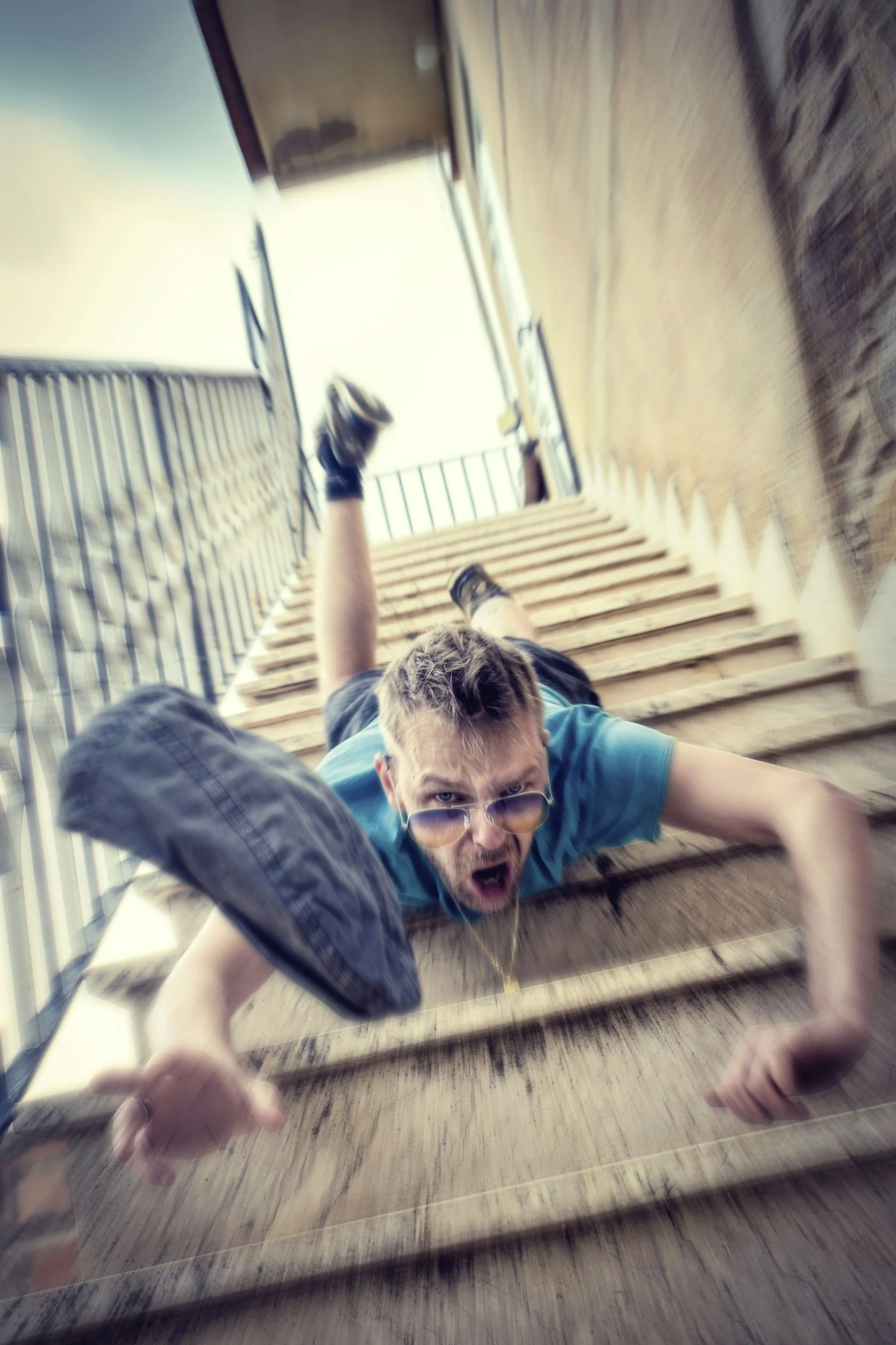
No we said walking down the stairs - not head first - but this will also hurt your knees going ‘down the stairs’
The Downward Staircase Dilemma
For active residents in Toronto, descending stairs is an unavoidable part of daily life. Whether you are navigating the deep steps of a TTC subway station, leaving your Queen West apartment, or hiking the trails in High Park, walking downward places immense sheer force on your lower body.
Many individuals experience a deeply unsettling phenomenon during this specific movement: their kneecap audibly "clicks," "pops," or physically feels as though it is sliding out of place before snapping back. This "giving way" or loose sensation triggers immediate anxiety, leading patients to rigidly lock their legs or avoid stairs altogether.
Walk-in clinics often dismiss this as generic "Runner's Knee" and prescribe a compressive sleeve. However, at Rehab Mechanics, we know that a clicking, shifting kneecap is a specific biomechanical failure known as Patellar Instability or Patellar Mal-tracking. If ignored, this chronic shifting acts like sandpaper, prematurely wearing away the cartilage behind your kneecap. By analyzing and correcting the muscular forces acting on your knee, specialized physical therapy can securely anchor your patella and restore your confidence on the stairs.
Structural / Biomechanical Analysis
To understand why your kneecap is shifting, we must perform a detailed structural analysis of the knee extensor mechanism and the forces that guide it.
The Trochlear Groove
Your kneecap (patella) is a floating bone embedded inside your massive quadriceps tendon.
The Track: It is designed to glide up and down within a specific V-shaped bony trench on the front of your thigh bone (femur) called the trochlear groove.
The Balance of Forces: For the kneecap to stay perfectly centered in this groove, the muscles pulling it from the inside, outside, top, and bottom must possess perfectly balanced tension.
The Pathology of Patellar Mal-Tracking
In patellar instability, this balance is destroyed, and the kneecap is violently pulled off-center (usually toward the outside of the leg).
Vastus Medialis Oblique (VMO) Weakness
The VMO is the teardrop-shaped muscle on the inside of your thigh, just above the knee. Its exclusive job is to pull the kneecap inward during movement.
The Shutdown: If you have experienced knee swelling in the past, or if you sit at a desk all day, the VMO rapidly weakens and becomes neurologically delayed. It fails to fire fast enough to keep the kneecap centered.
Lateral Fascial Tightness
On the outside of your leg, the Iliotibial (IT) band and the lateral retinaculum exert an outward pull.
The Imbalance: If the VMO is weak and the outer structures are tight, the kneecap is physically dragged outward. As you bend your knee to step down a stair, the misaligned kneecap catches on the bony ridge of the groove, then loudly "clicks" or "pops" as it forces its way past the obstruction.
The Pelvic Drop (Dynamic Valgus)
The root cause is almost always higher up the kinetic chain.
If your side-hip muscle (gluteus medius) is weak, your thigh bone rotates inward when you bear weight on one leg (like stepping down a stair). This inward rotation physically knocks the groove out from underneath the kneecap, causing massive instability and cartilage wear.
Clinical Red Flags
We meticulously differentiate between simple patellofemoral pain and true structural instability:
The "J Sign": When extending the leg from a bent position, the kneecap visibly jumps outward in a "J" pattern at the very end of the movement.
Apprehension Test: Extreme anxiety or defensive muscle guarding when a physiotherapist gently attempts to push the kneecap outward.
Catching on Descent: An audible, painful click that reliably occurs when the knee is loaded eccentrically (walking down stairs or hiking downhill), but not when walking up.
Recurrent Subluxations: A history of the knee actually "giving out" or fully buckling during pivoting movements on a sports field.
Primary Source Proof
Clinical biomechanical research consistently demonstrates that targeted strengthening of the VMO and the gluteal complex is the definitive first-line intervention for stabilizing the patella and preventing long-term cartilage degradation.
The Rehab Mechanics Corrective Protocol
We do not just hand you a knee brace. We rebuild the muscular scaffolding required to hold the kneecap perfectly in place.
Phase 1 — Load Modification and Tissue De-Tethering
Lateral Release Techniques: Our physiotherapists use advanced manual therapy and instrument-assisted soft tissue mobilization (IASTM) to release the tight IT band, vastus lateralis, and lateral retinaculum, physically removing the outward pull on the patella.
McConnell Taping: Utilizing rigid kinesiology tape to mechanically pull the kneecap back into the center of the groove, providing immediate relief and stability when navigating stairs during the early rehab phase.
Phase 2 — Pelvic Fortification
Gluteus Medius Isolation: We must stop the thigh bone from rotating inward. We prescribe targeted banded lateral walks and clamshells to build a massive, stable lateral hip.
Core-to-Floor Integration: Ensuring the deep abdominal core fires properly to hold the pelvis level during single-leg weight-bearing.
Phase 3 — Gait Retraining / Mechanics Correction (VMO Resurrection)
VMO Biofeedback: Utilizing tactile cues and localized isometric holds (like Spanish Squats) to force the nervous system to re-engage the vastus medialis oblique, training it to fire before the outer thigh muscles.
Terminal Knee Extension (TKE): Heavy resistance band drills focusing on the final 15 degrees of leg straightening, which is where the VMO is most active in stabilizing the kneecap.
Phase 4 — Return-to-Activity Strategy
Eccentric Deceleration: We must train your body to handle the exact movement that causes the click. We implement slow, heavily controlled step-downs and eccentric split squats, closely monitoring your knee alignment.
Plyometric Stability: Progressing to rapid bounding and jumping mechanics, proving to the nervous system that the kneecap is securely anchored during high-velocity sports.
Related Conditions We Treat
Patellofemoral Pain Syndrome (Runner's Knee)
Chondromalacia Patellae
Patellar Tendinopathy (Jumper's Knee)
Iliotibial (IT) Band Syndrome
Knee Osteoarthritis
Meniscus Tears
Related Blogs
"Does Pain Behind the Kneecap Mean My Cartilage is Gone?"
"Will Foam Rolling Fix My IT Band Syndrome and Outer Knee Pain?"
"Solving Runner's Knee: A Deep Dive into Patellofemoral Mechanics"
Services Used in Treatment
Neuromuscular Re-Education
Gait Retraining
Strengthening Programs
Manual Therapy
Soft Tissue Release
Myofascial Release
Custom Orthotics
Shockwave Therapy
FAQ Section
1. Can physiotherapy assist in managing a clicking kneecap?
Yes. Physiotherapy supports recovery by addressing the muscular imbalances pulling the kneecap off-center, helping to optimize movement and safely restore proper tracking within the joint groove.
2. Is it dangerous if my knee clicks without pain?
Painless clicking is common, but it indicates a mechanical tracking issue. Over time, this friction can contribute to cartilage wear. We assist in managing these mechanics to support long-term joint health.
3. Will wearing a knee brace stop my patella from slipping?
A brace offers temporary support, but it does not fix the underlying muscular weakness. We focus on neuromuscular re-education to build your own "biological brace" for durable stability.
4. Why does my knee only pop when walking down stairs?
Descending stairs requires intense eccentric contraction of your quadriceps, which places the highest pressure on the kneecap. If your tracking is off, the patella catches and pops. We help reduce this mechanical overload.
5. How does hip strength impact my kneecap?
Your glute muscles control the angle of your thigh bone. We focus on strengthening these stabilizers to prevent the inward rotation that violently forces the kneecap out of alignment.
6. Do I need surgery for a loose kneecap?
In many cases, no. Unless you have suffered a catastrophic dislocation tearing the medial ligaments, conservative physical therapy helps address contributing factors and restore stability without surgical intervention.
7. Can tight outer leg muscles cause patellar instability?
Absolutely. A tight IT band and lateral structures physically drag the kneecap outward. We utilize soft tissue release to provide mechanical slack and support optimal joint alignment.
8. How long does it take to stabilize the patella?
Rebuilding neurological motor control takes time. While taping provides immediate relief, building the VMO and gluteal strength required for permanent stability typically involves 6 to 10 weeks of progressive strengthening programs.
How Physiotherapy Helps
Reducing tissue irritation through targeted lateral release
Correcting pelvic drop to prevent dynamic valgus collapse
Improving cadence and eccentric stair-descent mechanics
Strengthening stabilizers in the VMO and gluteus medius
Reducing mechanical overload on the retropatellar cartilage
Improving foot mechanics to anchor a stable kinetic chain
Contact Us Today — All you have to lose is the pain
Book a comprehensive biomechanical knee assessment with our clinical team today. Located inside the Prime Medical Centre at 68 Abell Street, Queen West.
Email: info@rehabmechanics.com Phone: (416) 533-3900