Is the Stabbing Pain Between My Shoulder Blades a Pulled Muscle or a Neck Problem?
No, chronic pain between the shoulder blades is rarely a pulled muscle. It is usually referred pain from the lower cervical spine or an irritated dorsal scapular nerve caused by forward-head posture. Physiotherapy cures this by decompressing the neck and restoring thoracic mobility, completely eliminating the structural nerve irritation.
The Illusion of the "Unfixable Knot"
If you work in a high-demand office environment in Toronto's Financial District or spend hours designing on a tablet in Liberty Village, you are likely intimately familiar with "the knot."
It is a sharp, burning, deeply annoying ache located directly between your spine and your shoulder blade (scapula). The pain is so specific that you can often press a tennis ball or a massage cane right into the epicenter of the ache. Patients will spend hundreds of dollars on deep tissue massages, vigorously foam roll their mid-back, and stretch their arms across their chests. The massage feels fantastic for a few hours, but by the time they sit back down at their desk, the sharp, knifing pain has returned in the exact same millimeter of tissue.
Why is this "knot" completely immune to massage and stretching?
Because the muscle itself is not the problem. It is the innocent victim of a neurological illusion. At Rehab Mechanics in Queen West, we specialize in mapping complex neural pathways. That stabbing pain in your mid-back is almost certainly originating in your neck. By treating the cervical spine and correcting the biomechanics of your posture, we can permanently turn off the false pain signal.
Structural Analysis: The Mechanics of Referred Pain
To understand how your neck can cause burning pain in your mid-back, we must perform a detailed neurological and anatomical analysis of the cervicothoracic junction.
The "Pulled Rhomboid" Fallacy
The muscle located between your spine and your shoulder blade is called the rhomboid. When patients feel pain here, they assume they have "pulled" or "strained" the muscle.
The Reality: A true muscle strain occurs from acute, heavy lifting trauma (like violently pulling a heavy barbell). It heals within a few weeks. If your pain has lingered for months and worsens when you sit at a desk, it is not a muscle tear. It is a nerve issue.
The Neurological Pathway: Cervical Radiculopathy
Your spine is the central highway for your nervous system. The nerves that supply sensation and power to your upper back, shoulders, and arms exit the spinal cord through the lower vertebrae of your neck (specifically C4, C5, C6, and C7).
The Cervical Disc Bulge
When you adopt a "Tech Neck" posture (staring down at a screen), your head translates forward. This places massive, uneven pressure on the front of the cervical discs in your neck.
Over time, the gel-like center of the lower cervical discs (typically C5-C6 or C6-C7) bulges backward into the spinal canal.
This bulging disc physically presses against the exiting nerve root.
The Phenomenon of Referred Pain
When a nerve is crushed at its root (in the neck), the brain becomes confused. It doesn't necessarily feel the pain in the neck. Instead, the brain projects the pain down the length of the nerve to the area the nerve is supposed to supply.
The nerves from the lower neck supply the skin and deep tissue directly over the shoulder blade.
Therefore, a crushed disc in your neck creates a phantom, burning "knot" in your mid-back.
The Dorsal Scapular Nerve Entrapment
There is a second structural pathway for this pain: the Dorsal Scapular Nerve.
This specific nerve exits your mid-neck, travels through the scalene muscles on the side of your throat, and tunnels all the way down to plug directly into the rhomboid muscles between your shoulder blades.
If your neck muscles are in severe spasm from holding your heavy head forward all day, they act like a vice grip, crushing the dorsal scapular nerve in your throat. This "strangulation" causes an intense, electrical, aching pain in the rhomboids.
Identifying the Clinical Red Flags: Neck vs. Back
How do our physiotherapists prove that your mid-back pain is actually a neck problem? We use targeted structural provocation tests.
The Neck Extension Test: If you sit up straight and tilt your head backward to look at the ceiling, does the pain between your shoulder blades sharply increase? If yes, it is a cervical disc issue. Tilting backward physically closes the space in your neck, crushing the nerve harder and instantly amplifying the mid-back pain.
The Spurling’s Test: If we apply gentle downward pressure to the top of your head while your neck is tilted, it compresses the cervical nerve roots. If this instantly triggers the familiar burning between your shoulder blades, the diagnosis is definitively cervical.
The Relief Posture: Does placing your hand on top of your head or resting your chin on your chest relieve the mid-back ache? These postures open the nerve spaces in the neck, temporarily stopping the signal.
Primary Source Proof: Cervical Decompression
Orthopedic and neurological literature unequivocally demonstrates that resolving chronic interscapular (shoulder blade) pain requires directed manual therapy, traction, and stabilization of the cervical spine, completely outperforming localized treatment of the mid-back muscles.
Note: The link above directs to external, peer-reviewed medical literature demonstrating our commitment to evidence-based practice and international clinical guidelines for neurological rehabilitation.
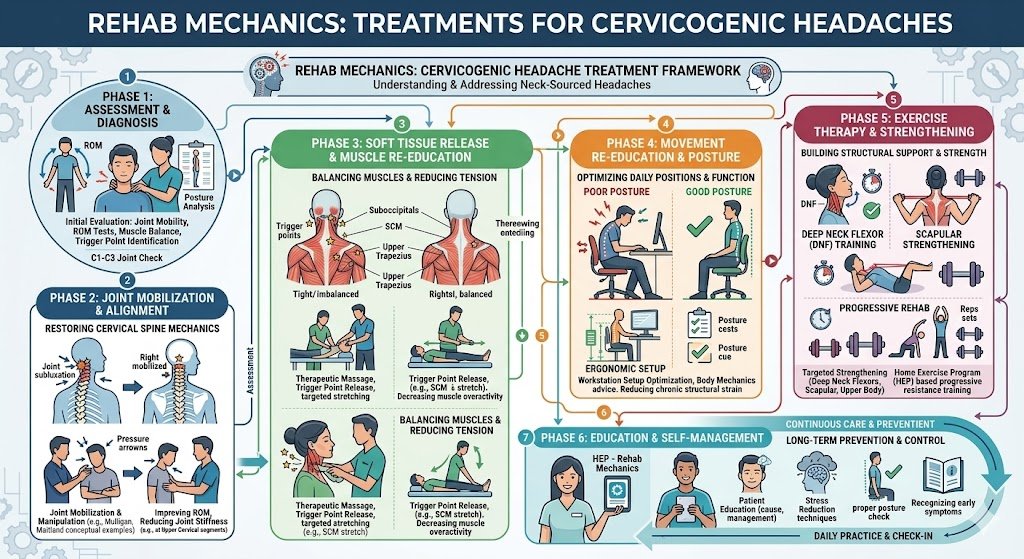
The Rehab Mechanics Diagnostic and Corrective Protocol
We do not waste time massaging your rhomboids. To cure the pain, we must immediately decompress the cervical nerve roots and rebuild the posture that caused the compression.
Phase 1: Cervical Nerve Decompression (Weeks 1-3)
Our absolute first priority is getting the pressure off the nerve in your neck.
Cervical Retraction (The McKenzie Method): We teach you highly specific, repeated movements (like the "chin tuck") to alter the hydraulic pressure inside your cervical discs. This physically milks the bulging disc material forward, away from the crushed nerve root, centralizing and eliminating the shoulder blade pain.
Manual Cervical Traction: Our physiotherapists apply gentle, sustained upward pulling to the base of your skull. This separates the cervical vertebrae by millimeters, instantly opening the nerve canals (foramina) and giving the suffocating nerve room to breathe.
Scalene Release: Deep myofascial release on the side of the neck to un-trap the dorsal scapular nerve.
Phase 2: Thoracic Mobility and Unlocking (Weeks 3-6)
Your neck cannot sit straight if your mid-back is frozen in a hunch.
Thoracic Extension Mobilization: Utilizing high-grade manual manipulations and fulcrum stretching over a foam roller to forcefully restore the ability of your upper back to arch backward. If the mid-back moves correctly, the neck does not have to hinge and crush the discs to look straight ahead.
Pectoral Fascial Lengthening: Releasing the tight chest muscles that act as heavy anchors, dragging the shoulder blades and the neck forward.
Phase 3: Deep Cervical and Scapular Fortification (Weeks 6-10)
We must build the biological endurance to keep the nerve spaces permanently open.
Deep Cervical Flexor Activation: Re-awakening the tiny muscles in the front of the throat that act as the internal core of the neck, holding the head back over the shoulders automatically.
Lower Trapezius Loading: Instead of stretching the rhomboids, we must strengthen the entire mid-back complex using heavy Y-raises and rows, building the muscular scaffolding that prevents the spine from collapsing into "Tech Neck."
Silence the False Alarm
Do not spend another year chasing a "muscle knot" that does not exist. By accurately mapping your neurological pathways and aggressively treating the structural failure in your cervical spine, specialized physical therapy can permanently eradicate the stabbing pain in your mid-back.
Book a comprehensive neurological and spinal assessment with our clinical team today. We are conveniently located inside the Prime Medical Centre at 68 Abell Street, offering advanced orthopedic recovery in Queen West.
Contact us to schedule your appointment:
Email: info@rehabmechanics.com
Phone: (416) 533-3900
About the Author
Mr. Sanjay Attwala (B.Sc., M.Sc., RPT) is a Registered Physiotherapist, clinical director, and the founder of Rehab Mechanics in Toronto. With over 15 years of registered clinical practice and a deep specialization in complex musculoskeletal rehabilitation, Sanjay synthesizes rigorous international academic training with advanced evidence-based therapeutics to guide his clinical practice and patient education initiatives.
Academic Background & Credentials
Master of Science (M.Sc.) in Physiotherapy – University of Keele, United Kingdom (2010).
Bachelor of Science (B.Sc.) – University of Waterloo, Ontario, Canada.
Registered Physiotherapist (RPT) – Regulated health professional in excellent standing with the College of Physiotherapists of Ontario (CPO).
Corporate Entity – Operating officially under the S. Attwala Physiotherapy Professional Corporation with a DBA of Rehab Mechanics.
Clinical Expertise & Philosophy
Sanjay’s clinical approach rejects passive symptom management in favor of identifying underlying biomechanical root causes. His diverse expertise spans advanced manual therapies, personalized corrective exercise prescription, and modern physical modalities. At the Rehab Mechanics Toronto Queen West clinic, he routinely diagnoses and treats complex conditions including:
Spinal & Discogenic Pathology – Cervical, thoracic, and lumbar disc injuries, sciatica, and sacroiliac joint (SIJ) dysfunction.
Upper & Lower Extremity Injuries – Rotator cuff tears, frozen shoulder, tennis/golfer’s elbow, carpal tunnel syndrome, and complex ankle/foot pathologies.
Perinatal & Pelvic Health Rehabilitation – Specialized assessment and rehabilitation protocols tailored specifically for women during pregnancy and the post-partum period, addressing pelvic girdle pain, diastasis recti, and core stabilization.
Specialized Rehabilitation – Pelvic health therapy, TMJ dysfunction, post-surgical rehabilitation (including Total Hip and Total Knee Replacements), and custom orthotics dispensing.
Shockwave Therapy: with advanced cutting edge technological devices to suit your needs.
Interdisciplinary Practice & Patient Care
Sanjay practices an integrated model of healthcare, working closely alongside medical doctors inside the Prime Medical Centre on Abell Street to streamline patient recovery pathways. He maintains a human-centric, communication-first clinical framework, ensuring that care remains fully customized rather than automated.
His clinical caseload encompasses a broad operational spectrum under Ontario's regulatory frameworks, including:
Motor Vehicle Accident (MVA) Claims – Rehabilitation navigating Ontario’s statutory accident benefits schedule.
Workplace Safety and Insurance Board (WSIB) – Occupational injury management and return-to-work screening.
Extended Health Care (EHC) & Private Practice – Multi-tier insurance coordination and long-term athletic development plans.
Commitment to Research & Community
Outside of his clinical caseload at Rehab Mechanics and his additional practice affiliations in Etobicoke, Sanjay is an active health writer and community educator. He translates contemporary peer-reviewed medical research into accessible, actionable guidance on his professional blog. As a dedicated father and husband, he mirrors his professional advice in his personal life, focusing on structural mobility, cross-training, and longevity to help his family and his community thrive. Naturally he takes he a keen interest in rehabilitation for women who are pregnant and post-partum.
Disclaimer: The information provided on this blog is intended for educational and informational purposes only. It does not constitute medical advice, diagnosis, or a treatment plan. Always seek the direct advice of a Registered Physiotherapist, physician, or other qualified health provider regarding any medical condition or physical rehabilitation routine.
Be sure to check out Rehab Mechanics’ Google My Business Profile for daily posts, location and directions in addition to the directions on the website!
We love interacting with prospective and current patients, and love honest feedback and even constructive criticism and areas for improvement!