Do I Need Surgery for a Torn MCL in My Knee?
No. The vast majority of Medial Collateral Ligament (MCL) tears heal perfectly without surgery. Expert physiotherapy utilizes hinged bracing, early valgus-protected range of motion, and aggressive quadriceps strengthening to restore joint stability and return you to high-level sports.
The Trauma of the Lateral Collision
When burritos and tacos turned into trauma. We feel and heal the pain with you!
Toronto is a city of high-intensity sports. Whether you are playing in a highly competitive winter hockey league, tackling a weekend soccer match at Lamport Stadium, or skiing on the escarpment just outside the city, your knees are subjected to immense, unpredictable forces.
One of the most common and terrifying knee injuries occurs when an athlete is struck forcefully on the outside of their knee while their foot is planted, or when they "catch an edge" and their knee violently buckles inward. The result is a sharp, tearing sensation on the inner aspect of the knee, followed by immediate, severe pain and a sensation of "wobbliness."
When an MRI confirms a tear of the Medial Collateral Ligament (MCL), many athletes assume their season is over and that reconstructive surgery is inevitable—especially if they know someone who required surgery for an ACL tear.
However, at Rehab Mechanics, we want to deliver highly reassuring clinical news: the MCL is not the ACL. Due to its unique anatomical position and incredible biological healing capacity, the vast majority of MCL tears—even severe, complete ruptures—heal structurally and functionally through aggressive, highly supervised physiotherapy without the need for a scalpel.
Structural Analysis: The Mechanics of the Medial Knee
To understand why the MCL can heal itself, we must perform a detailed biomechanical analysis of the inner knee architecture and how it reacts to trauma.
The Biological "Seatbelt" of the Knee
The knee is a massive hinge joint. To prevent it from bending sideways, it is strapped together by thick, dense bands of connective tissue called collateral ligaments.
The Anatomy: The Medial Collateral Ligament (MCL) is a broad, flat band that connects the inside of your thigh bone (femur) to the inside of your shin bone (tibia).
The Mechanical Function: Its absolute primary job is to resist valgus force—meaning it physically prevents your knee from collapsing inward toward your other leg.
The Valgus Collapse (The Mechanism of Injury)
When a heavy force strikes the outside of your knee, it drives the joint inward. The MCL is violently stretched. If the force exceeds the tensile strength of the ligament, it tears.
Grade 1: A mild sprain. Micro-tearing of the fibers, resulting in localized tenderness but no actual joint instability.
Grade 2: A moderate, partial tear. Significant pain, swelling, and a feeling that the knee is slightly "loose" or wobbly.
Grade 3: A complete, catastrophic rupture of the ligament. The knee opens up on the inside like a book when tested.
The Healing Advantage: Rich Blood Supply
Why does an ACL tear require surgery, but an MCL tear does not? The answer is biology.
The ACL lives deep inside the joint capsule in a harsh, synovial fluid environment with terrible blood supply. When it snaps, it cannot repair itself.
The MCL is located on the outside of the joint capsule. It is heavily embedded in a rich, vascular network of blood vessels. When it tears, it is immediately flooded with healing nutrients, immune cells, and fibrinogen, allowing it to rapidly scar back together and heal solidly.
Primary Source Proof: Non-Operative MCL Rehabilitation
Orthopedic sports medicine literature is definitive: conservative management with functional bracing and early, controlled physical therapy is the gold standard for isolated Grade 1, 2, and even Grade 3 MCL tears, resulting in excellent return-to-sport rates.
Note: The link above directs to external, peer-reviewed medical literature demonstrating our commitment to evidence-based practice and international clinical guidelines for sports trauma rehabilitation.
Conservative Management of Isolated Medial Collateral Ligament Injuries
Conservative management is widely regarded as the preferred first-line approach for isolated medial collateral ligament (MCL) injuries. Current clinical literature supports non-operative treatment for most Grade I and Grade II injuries, and for selected uncomplicated Grade III tears, particularly when there is no significant valgus malalignment, bony avulsion, or associated intra-articular pathology requiring surgical intervention.
Typical conservative care includes initial symptom control with rest, ice, compression, and elevation; early protected range-of-motion exercises; use of a hinged knee brace when clinically indicated; and progressive weight-bearing as tolerated. Rehabilitation generally emphasizes restoration of knee motion, gradual strengthening, neuromuscular control, and a staged return to activity.
Reviews indexed in PubMed and available through the National Library of Medicine describe generally favourable outcomes following non-operative treatment of isolated MCL injuries. Most patients regain functional knee stability and are able to return to sport or usual activities without persistent instability. Early controlled motion and progressive loading are commonly favoured over prolonged immobilization, although published rehabilitation protocols vary considerably in their level of detail and specific bracing recommendations.
Expected recovery time depends on the severity of the injury and the patient’s functional demands. Grade I sprains may improve within several weeks, while Grade II and Grade III injuries often require a longer rehabilitation period before unrestricted activity is appropriate. Surgical management is generally reserved for cases involving persistent valgus instability, severe malalignment, bony avulsion, ligament entrapment, chronic symptomatic instability, or complex combined ligament injury patterns.
When an MCL injury occurs in combination with an anterior cruciate ligament (ACL) tear, clinicians often initially manage the MCL component non-operatively to allow healing and improve knee motion before determining the optimal timing and strategy for ACL reconstruction. Overall, the available evidence and clinical consensus support individualized, criterion-based rehabilitation as the foundation of care for most isolated MCL injuries.
The Rehab Mechanics MCL Recovery Protocol
While the MCL can heal itself, it must be guided. If it heals too loose, you will suffer from chronic instability. If it heals too tight, your knee will be permanently stiff. We utilize a highly specific, phased protocol to ensure perfect structural alignment.
Phase 1: Absolute Protection and Scar Formation (Weeks 1-3)
The immediate goal is to physically hold the torn ends of the ligament together so they can fuse.
Hinged Bracing: For Grade 2 and 3 tears, we utilize a specialized, rigid hinged knee brace. This brace allows your knee to bend and straighten normally but completely blocks any side-to-side (valgus) wobbling, protecting the fragile healing tissue.
Swelling Eradication: Utilizing lymphatic drainage, compression, and elevation to flush out the massive pool of blood and fluid from the medial knee.
Quad Reactivation: Severe knee swelling instantly paralyzes the quadriceps muscle. We use Neuromuscular Electrical Stimulation (NMES) and pain-free isometric holds to force the quad to fire, preventing rapid muscle wasting.
Phase 2: Controlled Range of Motion and Strength (Weeks 3-6)
Once the biological glue has set, we must align the new collagen fibers.
Restoring Flexion and Extension: A knee that cannot straighten fully will cause a permanent limp. We aggressively restore your terminal extension using manual overpressure, while gently pushing your bending (flexion) capacity.
Closed Kinetic Chain Loading: Introducing highly controlled, straight-line exercises like leg presses, wall sits, and stationary cycling. We strictly avoid any twisting or lateral movements during this phase.
Phase 3: Dynamic Stability and Anti-Valgus Control (Weeks 6-10)
We must build a muscular exoskeleton around the healing ligament.
Gluteus Medius Fortification: If the side hip muscle is weak, the knee naturally caves inward. We aggressively strengthen the lateral hip to prevent this valgus collapse from ever happening again.
Proprioceptive Retraining: Using balance boards to re-teach the damaged nerve endings in the knee how to react instantly to unstable surfaces.
Phase 4: High-Velocity Return to Sport (Weeks 10+)
A healed ligament is useless if it cannot handle the chaos of the ice or the field.
Multi-Planar Agility: Progressing to rapid deceleration drills, lateral bounding (skater jumps), and strict cutting maneuvers. We do not clear you for competition until you can aggressively change direction with zero pain, instability, or hesitation.
Return to the Game Safely
A torn MCL does not mean your season is over. By respecting the biological healing timeline and aggressively rebuilding the muscular sling around your knee, you can completely restore your joint’s structural integrity without going under the knife.
Book a comprehensive sports trauma assessment with our clinical team today. We are conveniently located inside the Prime Medical Centre at 68 Abell Street, offering elite athletic recovery in Toronto Queen West.
Contact us to schedule your appointment:
Email: info@rehabmechanics.com
Phone: (416) 533-3900
About the Author
About the Author
Mr. Sanjay Attwala (B.Sc., M.Sc., RPT) is a Registered Physiotherapist, clinical director, and the founder of Rehab Mechanics in Toronto. With over 15 years of registered clinical practice and a deep specialization in complex musculoskeletal rehabilitation, Sanjay synthesizes rigorous international academic training with advanced evidence-based therapeutics to guide his clinical practice and patient education initiatives.
Academic Background & Credentials
Master of Science (M.Sc.) in Physiotherapy – University of Keele, United Kingdom (2010).
Bachelor of Science (B.Sc.) – University of Waterloo, Ontario, Canada.
Registered Physiotherapist (RPT) – Regulated health professional in excellent standing with the College of Physiotherapists of Ontario (CPO).
Corporate Entity – Operating officially under the S. Attwala Physiotherapy Professional Corporation with a DBA of Rehab Mechanics.
Clinical Expertise & Philosophy
Sanjay’s clinical approach rejects passive symptom management in favor of identifying underlying biomechanical root causes. His diverse expertise spans advanced manual therapies, personalized corrective exercise prescription, and modern physical modalities. At the Rehab Mechanics Toronto Queen West clinic, he routinely diagnoses and treats complex conditions including:
Spinal & Discogenic Pathology – Cervical, thoracic, and lumbar disc injuries, sciatica, and sacroiliac joint (SIJ) dysfunction.
Upper & Lower Extremity Injuries – Rotator cuff tears, frozen shoulder, tennis/golfer’s elbow, carpal tunnel syndrome, and complex ankle/foot pathologies.
Perinatal & Pelvic Health Rehabilitation – Specialized assessment and rehabilitation protocols tailored specifically for women during pregnancy and the post-partum period, addressing pelvic girdle pain, diastasis recti, and core stabilization.
Specialized Rehabilitation – Pelvic health therapy, TMJ dysfunction, post-surgical rehabilitation (including Total Hip and Total Knee Replacements), and custom orthotics dispensing.
Shockwave Therapy: with advanced cutting edge technological devices to suit your needs.
Interdisciplinary Practice & Patient Care
Sanjay practices an integrated model of healthcare, working closely alongside medical doctors inside the Prime Medical Centre on Abell Street to streamline patient recovery pathways. He maintains a human-centric, communication-first clinical framework, ensuring that care remains fully customized rather than automated.
His clinical caseload encompasses a broad operational spectrum under Ontario's regulatory frameworks, including:
Motor Vehicle Accident (MVA) Claims – Rehabilitation navigating Ontario’s statutory accident benefits schedule.
Workplace Safety and Insurance Board (WSIB) – Occupational injury management and return-to-work screening.
Extended Health Care (EHC) & Private Practice – Multi-tier insurance coordination and long-term athletic development plans.
Commitment to Research & Community
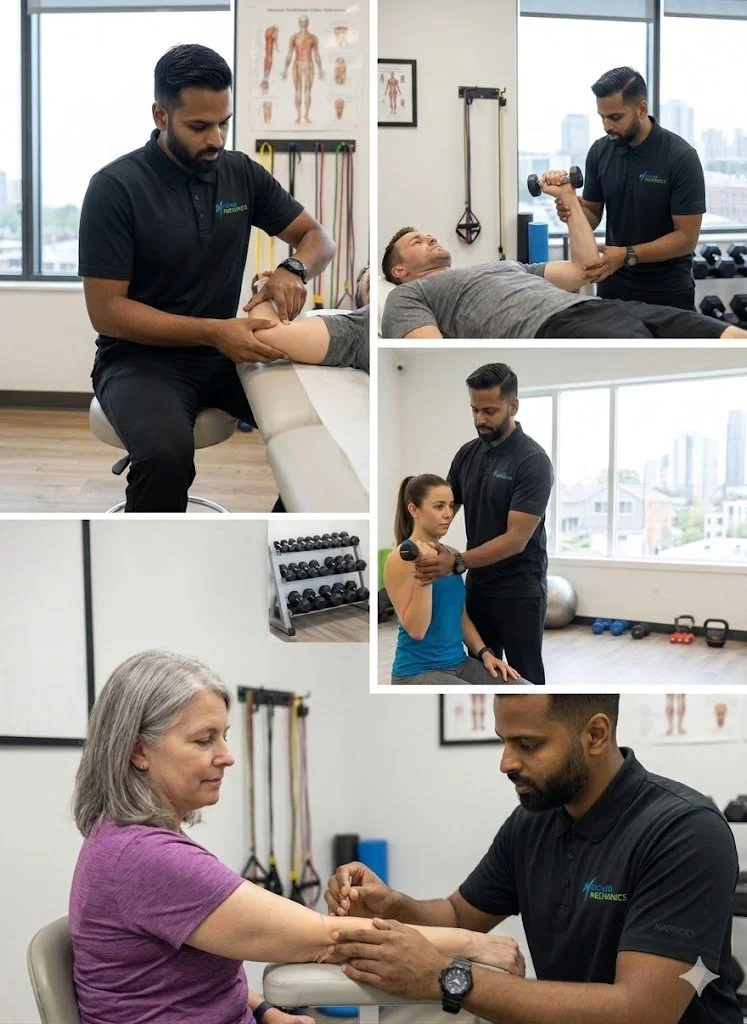
Outside of his clinical caseload at Rehab Mechanics and his additional practice affiliations in Etobicoke, Sanjay is an active health writer and community educator. He translates contemporary peer-reviewed medical research into accessible, actionable guidance on his professional blog. As a dedicated father and husband, he mirrors his professional advice in his personal life, focusing on structural mobility, cross-training, and longevity to help his family and his community thrive. Naturally he takes he a keen interest in rehabilitation for women who are pregnant and post-partum.
Disclaimer: The information provided on this blog is intended for educational and informational purposes only. It does not constitute medical advice, diagnosis, or a treatment plan. Always seek the direct advice of a Registered Physiotherapist, physician, or other qualified health provider regarding any medical condition or physical rehabilitation routine.