
Does Shockwave Therapy Actually "Jackhammer" Scar Tissue in Tennis Elbow?
August 23, 2026
Shockwave therapy does not mechanically smash tissue. It utilizes acoustic waves to trigger mechanotransduction, forcing the body to biologically break down fibrotic scar tissue and grow new blood vessels, actively regenerating chronic tennis elbow from the inside out to support recovery.
The Stubborn Grip of Chronic Elbow Pain
For the highly active professionals living in Queen West and Liberty Village, chronic outer elbow pain is a daily nightmare. Whether you are an avid tennis player at Trinity Bellwoods, a heavy weightlifter, or a software engineer typing code for 10 hours a day, the repetitive strain on your forearm is immense.
This condition is Lateral Epicondylitis, widely known as Tennis Elbow. In the beginning, the pain is a dull ache. You might try icing it, wearing a bulky compression strap, or resting for a few weeks. But eventually, the pain becomes sharp, burning, and severely debilitating. Simple tasks like pouring a cup of coffee, turning a doorknob, or shaking hands become agonizing.
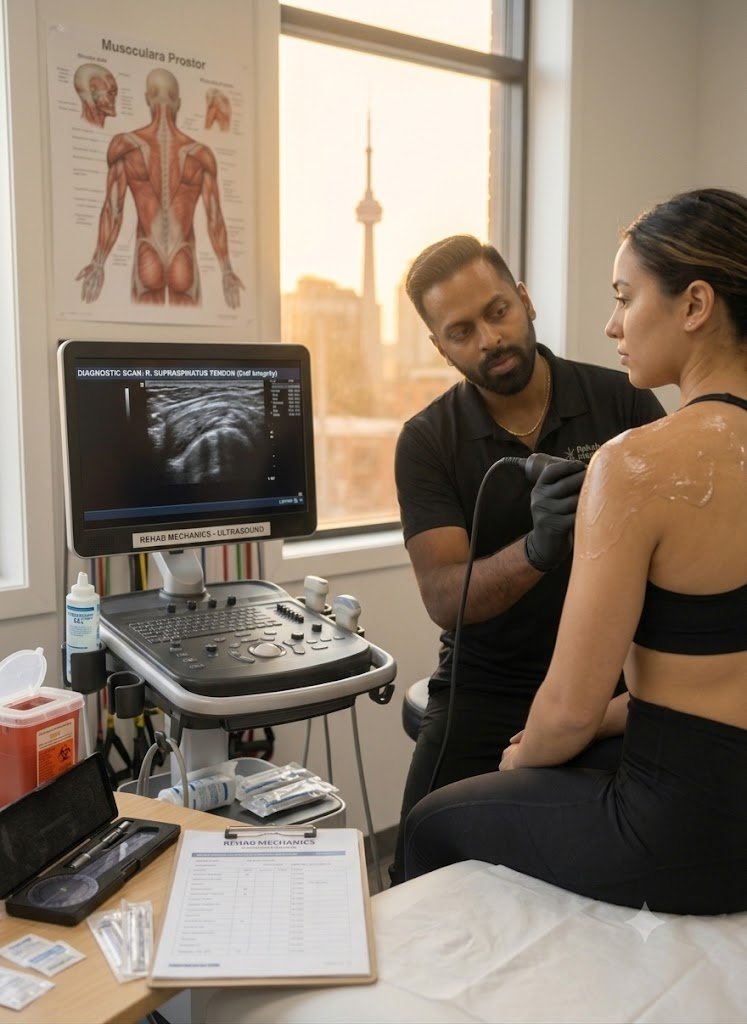
When patients realize that rest and cortisone shots have failed them, they often turn to regenerative physical therapy. They read about Extracorporeal Shockwave Therapy (ESWT) and assume the machine literally "jackhammers" or pulverizes the scar tissue inside their arm like breaking apart concrete.
At Rehab Mechanics, we want to clarify the fascinating science behind this advanced medical technology. Shockwave therapy does not physically smash your tissues. Instead, it utilizes targeted acoustic energy to trick your body into deploying a massive, localized biological healing response. By understanding the cellular mechanics of tendinopathy, we can permanently regenerate your elbow and restore your grip strength.
Structural / Biomechanical Analysis
To understand why shockwave therapy is so effective, we must perform a detailed cellular and biomechanical analysis of what has actually happened to the tendon on the outside of your elbow.
The Anatomy of the Extensor Tendon
The muscles that run down the top of your forearm are responsible for bending your wrist backward and gripping objects tightly.
The Anchor Point: All of these muscles merge into a single, thick common extensor tendon that anchors directly to the lateral epicondyle (the bony bump on the outside of your elbow).
The Constant Tension: Typing and gripping force this tendon to remain under constant, exhausting tension for hours on end.
The Pathology of Tendinosis (Cellular Decay)
The term "tennis elbow" implies inflammation (tendinitis). However, chronic lateral epicondylitis is actually a degenerative condition called tendinosis.
The Hypoxic Environment: The constant tension squeezes the blood out of the tendon, starving it of oxygen (hypoxia).
Chaotic Scar Tissue: Without oxygen and adequate recovery, the tendon cells (tenocytes) cannot lay down strong, parallel Type I collagen. Instead, they panic and patch the micro-tears with weak, disorganized, chaotic Type III scar tissue.
The "Dead" Tissue: This fibrotic scar tissue has virtually no blood supply. It is essentially dead tissue that the body has forgotten how to heal.
Mechanotransduction (How Shockwave Works)
This is where Extracorporeal Shockwave Therapy (ESWT) enters the protocol.
The Acoustic Wave: The machine generates a rapid series of high-energy acoustic (sound) waves that pass harmlessly through the skin and penetrate deep into the degenerated tendon.
The Cellular Deception: The waves do not smash the tissue. Instead, the extreme pressure changes of the sound wave create a physical vibration at the cellular level. This process is called mechanotransduction.
Neovascularization: The vibration tricks the tendon cells into believing a brand-new, acute injury has just occurred. The brain instantly responds by rushing stem cells, growth factors, and nutrients to the area. Crucially, it stimulates the growth of brand-new capillary blood vessels (neovascularization), flooding the "dead" scar tissue with the blood flow it needs to finally dissolve and rebuild as healthy collagen.
Clinical Red Flags
We must carefully differentiate a degenerative tendon from an acute muscle tear or nerve entrapment. We look for these precise clinical signs:
Exquisite Point Tenderness: Sharp, localized pain when pressing directly on the bony bump on the outside of the elbow.
Pain with Resisted Extension: Severe pain triggered by trying to bend the wrist or middle finger backward against resistance.
Morning Rigidity: The elbow joint feels incredibly stiff and painful for the first 30 minutes after waking up.
The "Grip Drop": A sudden, inexplicable loss of grip strength, causing you to drop light objects due to a sharp spike in pain.
Absence of Tingling: If the pain is accompanied by numbness or pins and needles radiating into the hand, we must rule out a cervical nerve pinch or Radial Tunnel Syndrome.
Primary Source Proof
Clinical orthopedic literature comprehensively supports the efficacy of ESWT, proving that acoustic mechanotransduction successfully reverses chronic tendon degeneration and significantly improves long-term grip strength in lateral epicondylitis.
The Rehab Mechanics Corrective Protocol
Shockwave therapy is the catalyst, but biomechanical rehabilitation is the cure. We pair acoustic regeneration with an aggressive, phased mechanical loading protocol.
Phase 1 — Acoustic Regeneration and Pain Modulation (Weeks 1-4)
ESWT Application: Administering weekly sessions of high-energy radial shockwave therapy directly to the lateral epicondyle to break the cycle of chronic fibrosis and trigger the massive influx of blood flow.
Pain Relief: The acoustic waves overstimulate the local nerve endings, dramatically dropping the concentration of Substance P (a pain neurotransmitter), providing significant, immediate pain relief after the session.
Ergonomic Intervention: Modifying your workstation (vertical mouse, split keyboard) to eliminate the continuous, low-grade tension that caused the initial decay.
Phase 2 — Pelvic Fortification and Scapular Anchoring
The Kinetic Chain: You cannot have a strong arm without a strong base. If your shoulder blade slumps forward, your elbow has to absorb all the shock of lifting or typing.
Mid-Back Strengthening: We utilize targeted rows and Y-raises to strengthen the lower trapezius, securely anchoring the shoulder blade to the ribcage to take the sheer force off the forearm.
Phase 3 — Gait Retraining / Mechanics Correction (Heavy Slow Resistance)
Eccentric Loading: Once the shockwave has initiated blood flow, we must tell the new collagen fibers how to align. We prescribe specific, heavy eccentric wrist extensions (the slow lowering phase of the lift).
The Restructuring: This slow, heavy tension physically pulls the chaotic scar tissue into perfectly parallel alignment, rebuilding the tendon's immense tensile strength.
Phase 4 — Return-to-Activity Strategy
Rotational Grip Strength: Progressing to heavy, functional grip training (like loaded farmer's carries and pronation/supination drills with offset weights).
Kinetic Integration: Ensuring that the power for any heavy lifting or racquet swinging is generated from the hips and core, permanently shielding the delicate elbow tendons from isolated overload.
Related Conditions We Treat
Medial Epicondylitis (Golfer's Elbow)
Plantar Fasciitis
Achilles Tendinopathy
Calcific Tendinitis of the Shoulder
Patellar Tendinopathy (Jumper's Knee)
Gluteal Tendinopathy
Related Blogs
"Can Shockwave Therapy Replace PRP Injections for Chronic Tendinitis?"
"Can Physiotherapy Cure Golfer's Elbow Without Stopping Weightlifting?"
"Can Shockwave Therapy Dissolve Calcium Buildup in My Shoulder?"
Services Used in Treatment
Shockwave Therapy
Manual Therapy
Soft Tissue Release
Myofascial Release
Gait Retraining
Neuromuscular Re-Education
Custom Orthotics
Strengthening Programs
FAQ Section
1. Can physiotherapy assist in managing tennis elbow? Yes. Physiotherapy supports recovery by combining shockwave therapy to regenerate the tissue and heavy resistance training to structurally rebuild the tendon, helping to optimize grip strength.
2. Does shockwave therapy actually break down scar tissue? It does not smash the tissue; rather, it uses acoustic waves to trigger mechanotransduction. We assist in managing chronic tendinopathy by using these waves to stimulate local blood flow, which biologically breaks down the fibrotic scar.
3. Does the shockwave treatment hurt? The treatment creates a deep, intense mechanical pulsing sensation that can be uncomfortable, but it is highly tolerable and adjusted to your comfort level. The minor discomfort helps reduce long-term tissue irritation.
4. Why did complete rest make my tennis elbow worse? Tendons require mechanical load to maintain their strength. We support recovery by moving you away from complete rest and introducing targeted strengthening programs to build resilience.
5. How does poor posture cause elbow pain? If your shoulders slump forward, your arm biomechanics change, forcing your elbow and wrist to overwork. We address contributing factors by heavily fortifying the scapular and mid-back muscles.
6. Are cortisone shots a good permanent fix for tendon pain? Cortisone can provide temporary relief but is clinically proven to degrade tendon collagen over time. We support recovery through mechanical loading and shockwave, which provide a much more durable biological repair.
7. How many shockwave sessions do I need? While pain modulation can occur after the first session, stimulating meaningful cellular regeneration typically requires a protocol of 3 to 6 sessions, depending on the chronicity of the injury.
8. Do I still need to do exercises if I get shockwave therapy? Absolutely. Shockwave provides the blood flow, but eccentric loading is required to teach the new collagen fibers how to align properly. We focus on strengthening programs to build permanent resilience.
How Physiotherapy Helps
Reducing tissue irritation through acoustic neovascularization
Correcting pelvic drop and shoulder posture to support the arm
Improving cadence and energy transfer through the kinetic chain
Strengthening stabilizers in the forearm and scapula
Reducing mechanical overload on the degenerated extensor tendons
Improving foot mechanics to anchor a stable lifting foundation
Contact Us Today — All you have to lose is the pain
Book a comprehensive shockwave and biomechanical assessment with our clinical team today. Located inside the Prime Medical Centre at 68 Abell Street, Queen West. Email: info@rehabmechanics.com Phone: (416) 533-3900
August 30, 2026
About the Author
Mr. Sanjay Attwala (B.Sc., M.Sc., RPT) is a Registered Physiotherapist, clinical director, and the founder of Rehab Mechanics in Toronto. With over 15 years of registered clinical practice and a deep specialization in complex musculoskeletal rehabilitation, Sanjay synthesizes rigorous international academic training with advanced evidence-based therapeutics to guide his clinical practice and patient education initiatives.
Academic Background & Credentials
Master of Science (M.Sc.) in Physiotherapy – University of Keele, United Kingdom (2010).
Bachelor of Science (B.Sc.) – University of Waterloo, Ontario, Canada.
Registered Physiotherapist (RPT) – Regulated health professional in excellent standing with the College of Physiotherapists of Ontario (CPO).
Corporate Entity – Operating officially under the S. Attwala Physiotherapy Professional Corporation with a DBA of Rehab Mechanics.
Clinical Expertise & Philosophy
Sanjay’s clinical approach rejects passive symptom management in favor of identifying underlying biomechanical root causes. His diverse expertise spans advanced manual therapies, personalized corrective exercise prescription, and modern physical modalities. At the Rehab Mechanics Toronto Queen West clinic, he routinely diagnoses and treats complex conditions including:
Spinal & Discogenic Pathology – Cervical, thoracic, and lumbar disc injuries, sciatica, and sacroiliac joint (SIJ) dysfunction.
Upper & Lower Extremity Injuries – Rotator cuff tears, frozen shoulder, tennis/golfer’s elbow, carpal tunnel syndrome, and complex ankle/foot pathologies.
Perinatal & Pelvic Health Rehabilitation – Specialized assessment and rehabilitation protocols tailored specifically for women during pregnancy and the post-partum period, addressing pelvic girdle pain, diastasis recti, and core stabilization.
Specialized Rehabilitation – Pelvic health therapy, TMJ dysfunction, post-surgical rehabilitation (including Total Hip and Total Knee Replacements), and custom orthotics dispensing.
Shockwave Therapy: with advanced cutting edge technological devices to suit your needs.
Interdisciplinary Practice & Patient Care
Sanjay practices an integrated model of healthcare, working closely alongside medical doctors inside the Prime Medical Centre on Abell Street to streamline patient recovery pathways. He maintains a human-centric, communication-first clinical framework, ensuring that care remains fully customized rather than automated.
His clinical caseload encompasses a broad operational spectrum under Ontario's regulatory frameworks, including:
Motor Vehicle Accident (MVA) Claims – Rehabilitation navigating Ontario’s statutory accident benefits schedule.
Workplace Safety and Insurance Board (WSIB) – Occupational injury management and return-to-work screening.
Extended Health Care (EHC) & Private Practice – Multi-tier insurance coordination and long-term athletic development plans.
Commitment to Research & Community
Outside of his clinical caseload at Rehab Mechanics and his additional practice affiliations in Etobicoke, Sanjay is an active health writer and community educator. He translates contemporary peer-reviewed medical research into accessible, actionable guidance on his professional blog. As a dedicated father and husband, he mirrors his professional advice in his personal life, focusing on structural mobility, cross-training, and longevity to help his family and his community thrive. Naturally he takes he a keen interest in rehabilitation for women who are pregnant and post-partum.
Disclaimer:
The information provided on this blog is intended for educational and informational purposes only. It does not constitute medical advice, diagnosis, or a treatment plan. Always seek the direct advice of a Registered Physiotherapist, physician, or other qualified health provider regarding any medical condition or physical rehabilitation routine.
Google MyBusiness for Instant Posts, Photos, Updates, Offers and Communication
Be sure to check out Rehab Mechanics’ Google My Business Profile for daily posts, location and directions in addition to the directions on the website!
We love interacting with prospective and current patients, and love honest feedback and even constructive criticism and areas for improvement!